
NVIDIA Is Moving Beyond the GPU
Within eleven days in August, NVIDIA announced plans for financing platforms intended to mobilize more than $500 billion in third-party capital for AI infrastructure, invested $1.5 billion in SB Energy around the massive PORTS-Pike project in Ohio, and then took a minority stake in Cloverleaf Infrastructure. The moves point to a broader strategy: NVIDIA is still selling GPUs, but it is increasingly participating in the financing, land, power and site infrastructure that determines where future AI compute can actually be built.
Three moves in eleven days
For years, NVIDIA’s strategic advantage in artificial intelligence could largely be described through one scarce resource: advanced computing hardware.
That picture is becoming incomplete.
Within eleven days in August, NVIDIA announced plans for financing platforms intended to mobilize more than $500 billion in third-party capital for AI infrastructure, invested $1.5 billion in SB Energy around the massive PORTS-Pike project in Ohio, and then took a minority stake in Cloverleaf Infrastructure, a company focused on the land, power and grid access needed for new data centers.
Taken separately, the moves are different.
Taken together, they raise a larger question:
Is NVIDIA beginning to secure not only demand for its AI compute, but also parts of the infrastructure that determine where that compute can actually be deployed?
On August 10, NVIDIA announced memorandums of understanding with Apollo, BlackRock, Blackstone, Brookfield, Goldman Sachs and KKR to establish independent compute-financing platforms.
The stated goal is to mobilize more than $500 billion of third-party capital for AI infrastructure over time. It is not $500 billion of NVIDIA spending, and the partnerships remain subject to final agreements. NVIDIA describes the broader objective as turning compute and full-stack AI infrastructure into an investable asset class.
Seven days later came Ohio.
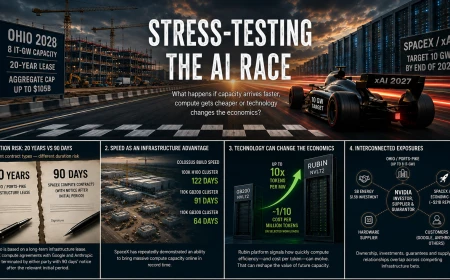
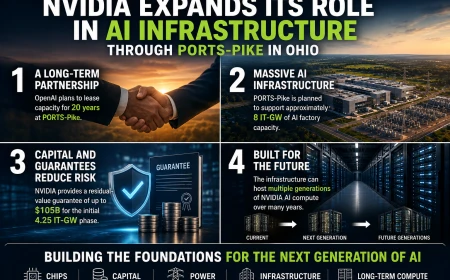
NVIDIA announced a $1.5 billion investment in SB Energy and credit support for the land, power and shell infrastructure at PORTS-Pike. The initial deployment is designed for approximately 4.25 IT-GW, NVIDIA has an option connected to the remaining 3.75 IT-GW, and OpenAI is expected to use the full 8 IT-GW campus. NVIDIA will be the exclusive AI compute infrastructure provider.
Then, on August 21, NVIDIA made a minority investment in Cloverleaf Infrastructure. Financial terms were not disclosed. Cloverleaf develops sites and power infrastructure for large data-center projects, while NVIDIA will work with the company on the infrastructure needed to support AI factories.
Three different moves.
But all three reach beyond simply manufacturing and selling a GPU.
The scarce resource is no longer only the chip
NVIDIA itself is unusually explicit about what it sees happening.
In discussing PORTS-Pike, the company called land, power and shell the next strategic resource for AI factories. NVIDIA said it is applying the same discipline to securing that capacity that it has used to secure critical semiconductor resources.
That matters because an AI processor has little economic value if there is nowhere to install and power it.
Large sites need land, grid connections, generation, cooling, permits and infrastructure capable of supporting enormous electrical loads.
Cloverleaf operates directly in that layer.
Its model emphasizes power-driven development and ready-to-build sites. The company says transmission infrastructure can take more than a decade to develop, while data-center projects often need to become operational within 24–36 months. That mismatch makes early access to energy infrastructure increasingly important.
The Cloverleaf partnership also brings NVIDIA’s DSX platform into decisions involving site selection, power, cooling, compute and facilities earlier in the design process.
NVIDIA is still selling GPUs.
But it is increasingly participating in the conditions that determine whether future GPU capacity can be installed at all.
Capital is becoming part of the infrastructure
Land and electricity are not the only constraints.
Somebody has to finance the buildout.
That is why the August 10 financing announcement belongs in the same picture.
NVIDIA and six major financial institutions are attempting to create dedicated pools of outside capital capable of financing AI infrastructure at much greater scale.
At the same time, the credit market is beginning to show that capital has a price.
Reuters reported on August 21 that the surge in AI-related technology debt is testing investor appetite. Credit quality among the largest issuers remains strong, but increasing supply has pushed some borrowers to offer greater concessions to attract investors.
That is not evidence that AI financing is drying up.
It does mean that expanding AI infrastructure cannot rely indefinitely on the assumption that enormous amounts of capital will always be available on equally attractive terms.
NVIDIA appears to be working on that bottleneck too.

Competition may begin before the GPU is installed
This makes the competitive question more interesting.
Chip companies can compete on performance, price, networking, software and customer relationships.
But if power-ready sites, grid connections and financing become scarce inputs, part of the competition may occur before a customer ever chooses which processor to install.
There is currently no evidence that NVIDIA’s investments in Cloverleaf or PORTS-Pike are preventing competing chip suppliers from accessing infrastructure.
That is not the argument.
The broader question is:
If access to land, power, grid capacity and financing becomes as strategically important as access to chips, does participation in the surrounding infrastructure become another competitive advantage?
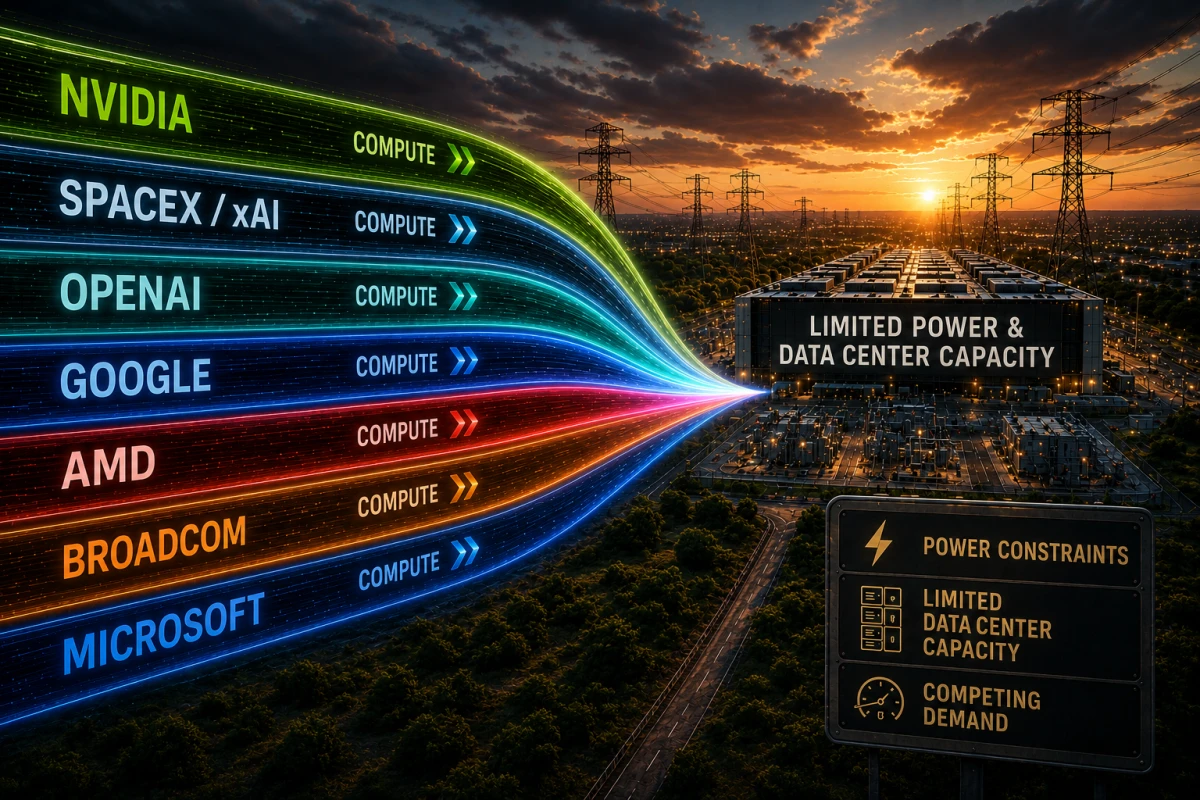
Within eleven days, NVIDIA made moves across several layers of the same system:
compute → financing → land → power → data-center capacity
The GPU remains at the center.
But the strategy around it is getting much larger.
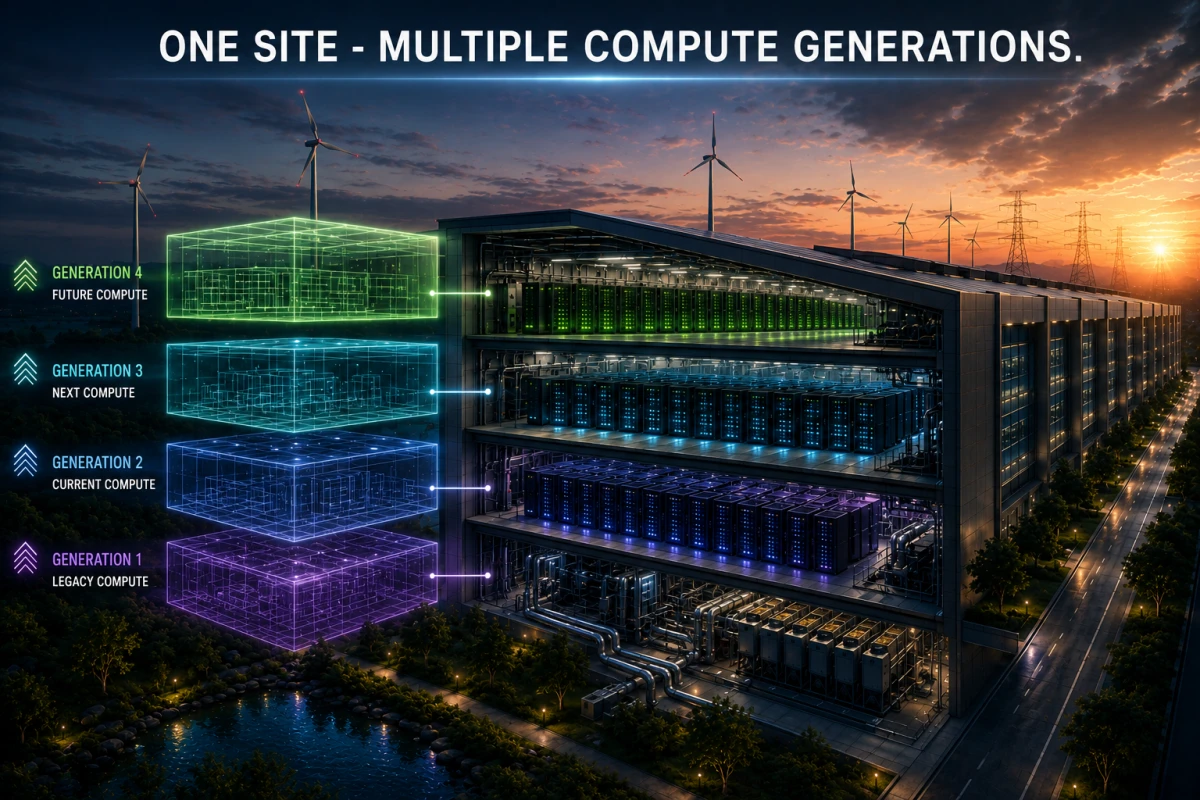
NVIDIA itself now talks about long-lived physical sites capable of hosting multiple generations of accelerated computing. At PORTS-Pike, the company says the infrastructure can support repeated upgrade cycles over the 20-year life of the site.
That leaves a longer question hanging over the AI buildout:
How much of the future of these facilities is already being decided today?
💬 What do you think?
If access to land, power, grid capacity and financing becomes more strategically important, how much of the AI competition may be decided before a GPU is ever installed?
Share your view in the comments.
📚 Related articles
Questions and Answers: NVIDIA Is Moving Beyond the GPU.
Vad är din reaktion?
 Gilla
0
Gilla
0
 Ogilla
0
Ogilla
0
 Kärlek
0
Kärlek
0
 Rolig
0
Rolig
0
 Wow
0
Wow
0
 Ledsen
0
Ledsen
0
 Arg
0
Arg
0

Hej, jag heter Staffan Carlsson
Jag är grundare och ansvarig utgivare för NextNet.se – en svensk nyhetsplattform med fokus på artificiell intelligens, teknik, cybersäkerhet och digital innovation.
Varför NextNet?
Jag startade NextNet med målet att skapa en modern och lättillgänglig nyhetssajt där teknik och AI står i centrum. Den tekniska utvecklingen går snabbare än någonsin, och jag tror att det är viktigare än någonsin att kunna förstå vad som händer – utan att behöva vara expert.
Genom NextNet vill jag lyfta fram nyheter, analyser och trender som hjälper läsare att navigera i en allt mer digital värld.
Mitt teknikintresse
Teknik har varit en stor del av mitt liv under många år. Jag fascineras av hur innovation, internet och artificiell intelligens förändrar sättet vi arbetar, kommunicerar och bygger framtidens samhälle.
Utöver arbetet med NextNet ägnar jag mycket tid åt webbplattformar, servermiljöer, AI-lösningar och digitala projekt där nyfikenhet och lärande alltid står i centrum.
Min vision
Jag vill att NextNet ska vara en trovärdig och inspirerande källa för alla som vill följa utvecklingen inom AI, teknik och digitalisering – oavsett tidigare kunskapsnivå.
AI-drivna nyheter för en digital värld.














Kommentarer (0)