
Stress-Testing the AI Race
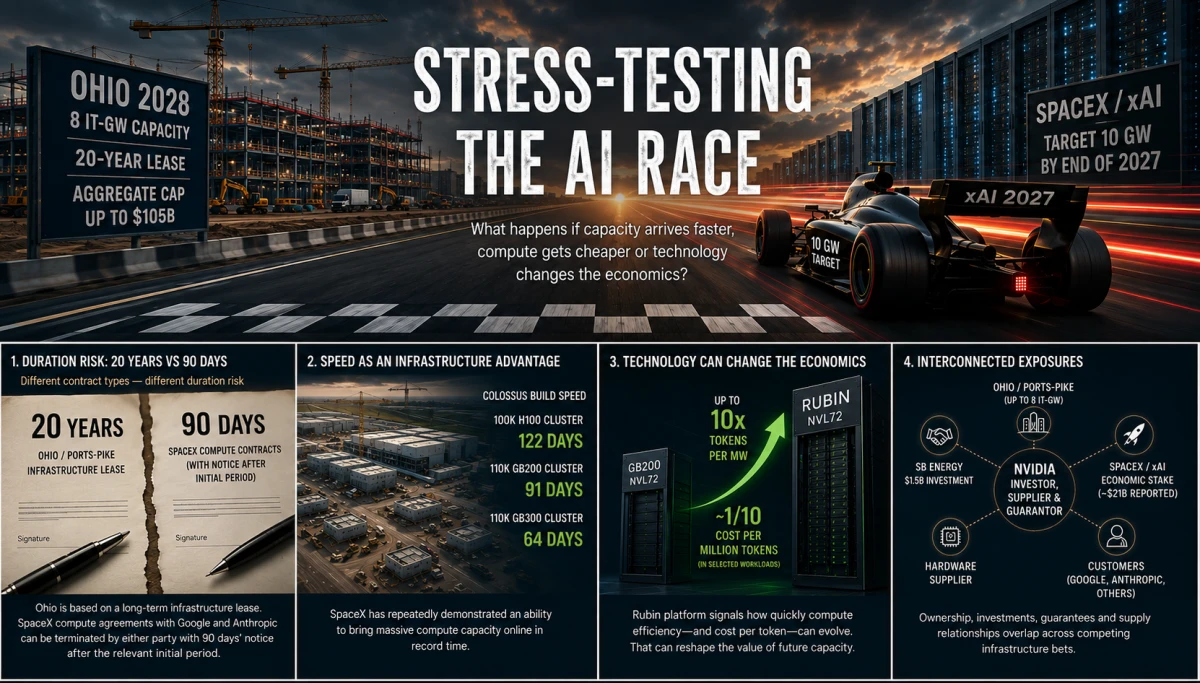
Ohio’s PORTS-Pike project expects its first major AI capacity in 2028. Elon Musk is targeting roughly 10 gigawatts of AI data-center capacity by the end of 2027. Meanwhile, NVIDIA is investing in infrastructure, providing enormous guarantees and supplying systems across increasingly interconnected parts of the AI economy. Behind the race are long-term leases, flexible compute contracts, power investments and huge assumptions about future demand. NextNet stress-tests the AI buildout: what happens if capacity arrives faster than expected, compute gets cheaper or technology changes the economics before today’s megaprojects are fully operational?
The AI race is becoming an infrastructure race
For most of the generative-AI boom, competition has been described through models, GPUs and software.
That is no longer enough.
The largest AI projects are increasingly competing over something far more physical: land, electricity, transmission capacity, cooling, data-center buildings, financing and the ability to turn all of those pieces into usable compute before competitors do.
Gigawatts have become part of the vocabulary of AI.
And with that shift comes a different kind of risk.
A software project can be abandoned relatively quickly.
A multi-gigawatt AI campus financed with equity, debt, long-term leases, power infrastructure and guarantees is much harder to unwind.
The important question is therefore no longer simply how much AI capacity the industry can build.
It is:
What still has to be true several years from now for today’s infrastructure investments to make economic sense?
Ohio and SpaceX represent two very different timelines
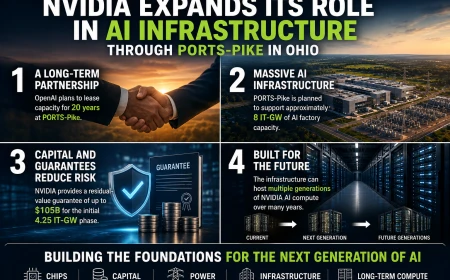
The new PORTS-Pike structure in Ohio provides one extreme.
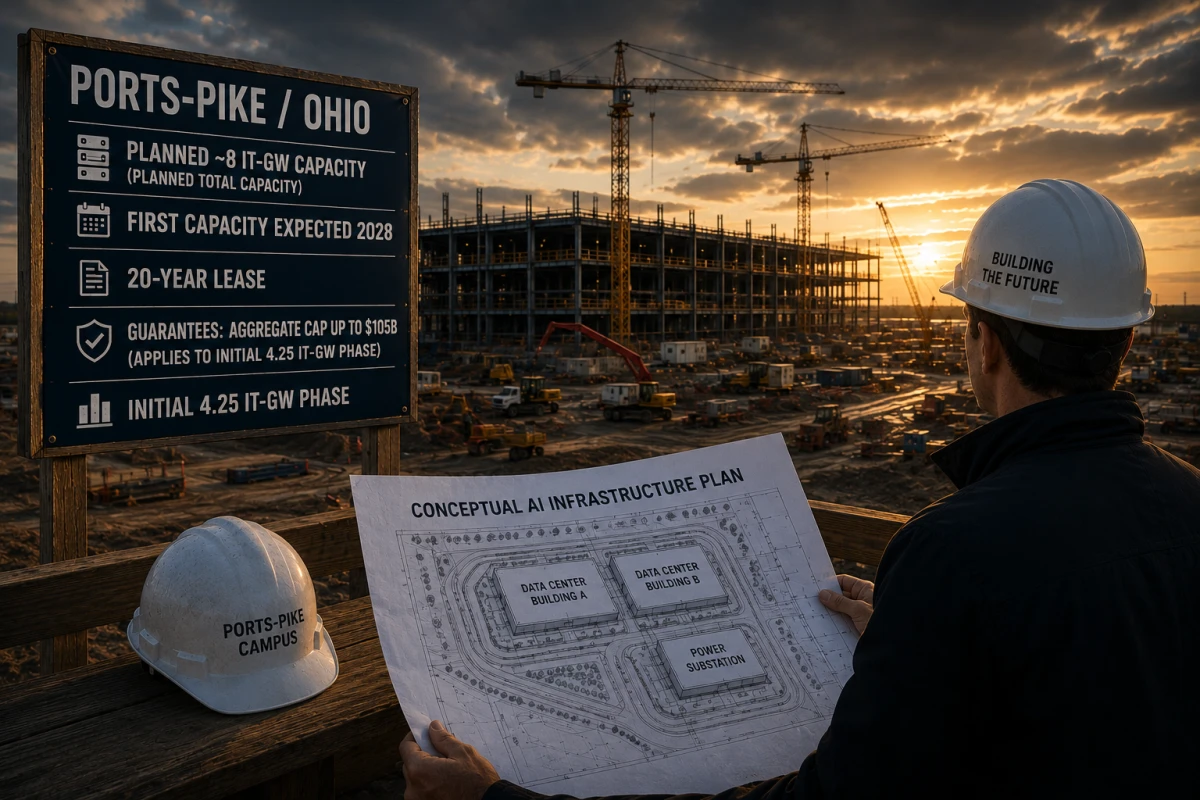
OpenAI has entered into a 20-year lease. NVIDIA is investing $1.5 billion in developer SB Energy and is supporting the first approximately 4.25 IT-GW phase through a guarantee structure with aggregate exposure capped at up to $105 billion.
The larger campus is expected to support as much as 8 IT-GW of capacity, but the first roughly 800 MW is expected to come online in 2028.
Then there is SpaceX and xAI.
Musk has told SpaceX employees that the company is aiming for approximately 10 GW of AI data-center capacity by the end of 2027, according to reporting by Tom’s Hardware. That remains a target — not future capacity that is already operating or guaranteed to be completed.
But SpaceX has already demonstrated unusually fast deployment.
Its SEC filings say the first Colossus cluster — approximately 100,000 H100 processors and 130 MW of compute power — was brought online in 122 days. The first Colossus II cluster, approximately 110,000 GB200 processors and 210 MW, took 91 days. A subsequent 110,000-GPU GB300 cluster representing about 220 MW was brought online in 64 days.
The contrast is striking.
Ohio represents enormous long-duration infrastructure built around a long lease, new power capacity and financial guarantees.
SpaceX is attempting to make speed itself an infrastructure advantage.
Neither approach is automatically superior.
But they put time — and therefore risk — in very different places.
The AI race is also a capital race
Building compute is only one part of the competition.
Someone must finance the land.
Someone must finance the buildings.
Someone must pay for generation and transmission capacity.
Someone must finance the servers.
And someone must ultimately generate enough cash flow to justify all of it.
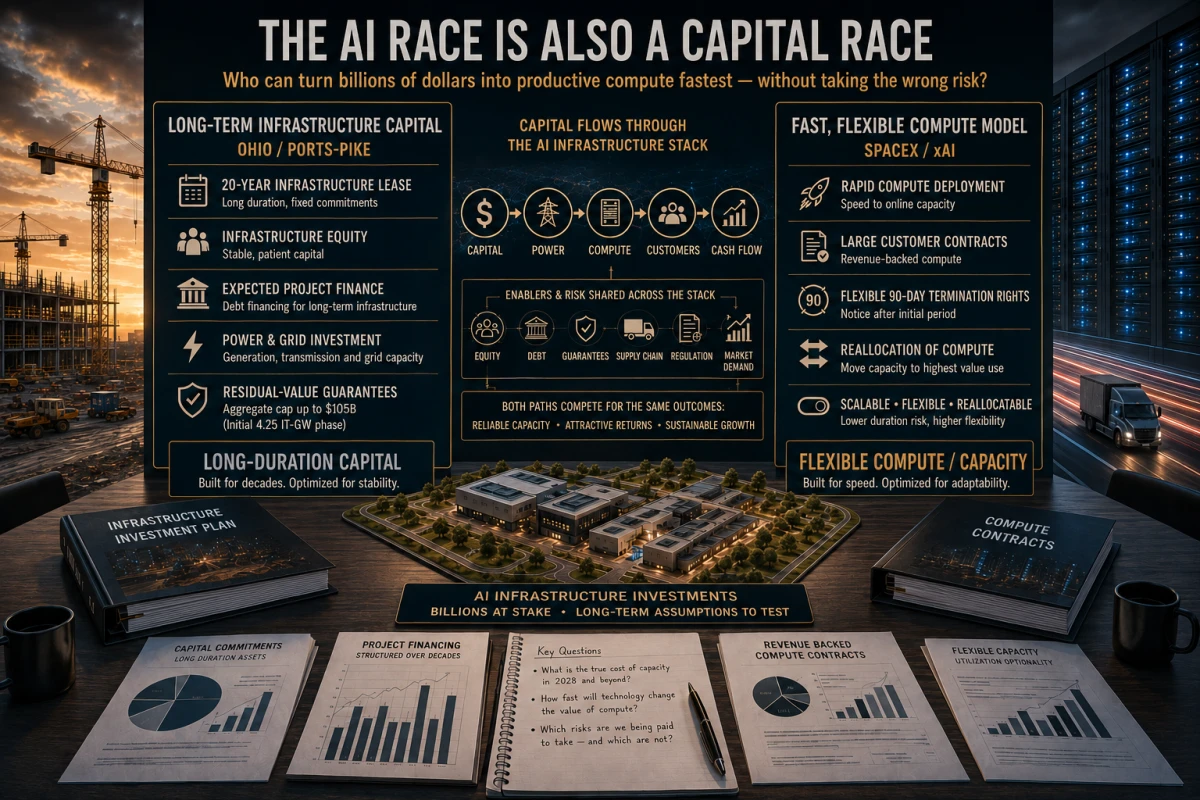
PORTS-Pike illustrates the long-duration version of that equation.
Its financing structure is not yet fully defined. Reuters reports that equity is expected first, followed by a debt component likely to include project-finance loans and potentially public bonds. NVIDIA’s guarantee can therefore matter even if NVIDIA never has to make a payment: its existence may change how lenders price part of the project’s risk.
SpaceX is experimenting with a different way to monetize infrastructure.
Instead of using all of its compute internally, it can sell access to outside customers while retaining the ability, under certain contracts, to reallocate capacity later.
That turns the AI race into more than a race for GPUs.
It becomes a race to transform:
capital → power → compute → customers → cash flow
faster and more efficiently than competitors.
And that raises another question:
Which financing structure remains resilient if the market looks different two years from now?
SpaceX already has large external compute customers
SpaceX is not relying entirely on its own AI products to monetize the infrastructure.
On June 5, SpaceX entered into a cloud-service agreement with Google covering access to compute capacity that includes approximately 110,000 NVIDIA GPUs.
Google agreed to pay SpaceX $920 million per month from October 2026 through June 2029, following a ramp period.
SpaceX has separately disclosed agreements with Anthropic covering approximately 325,000 NVIDIA GPUs, with payments of $1.25 billion per month through May 2029.
Those headline numbers are enormous.
But the contractual details reveal something even more interesting.
A multi-year compute deal can still have a 90-day exit
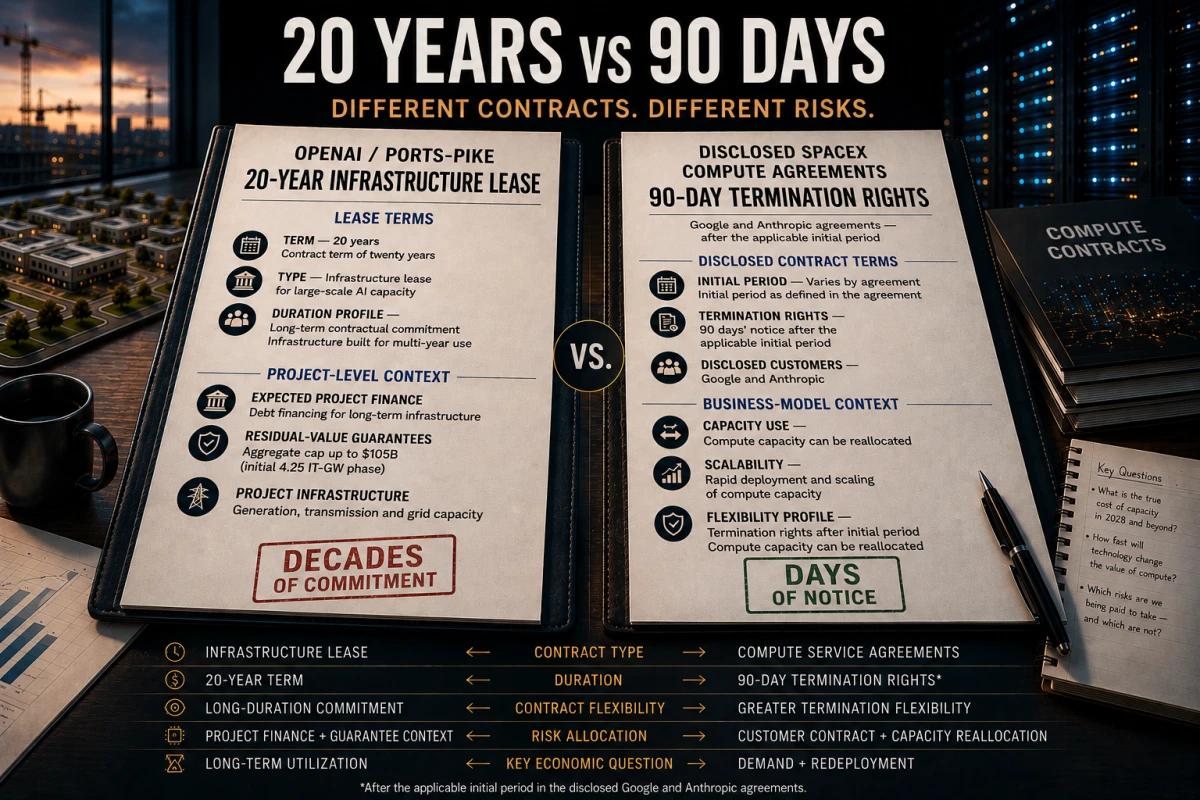
The Google agreement may run through June 2029, but after December 31, 2026, either party can terminate it with 90 days’ notice.
Google also has specific protections if SpaceX does not deliver the committed GPU capacity on schedule.
The disclosed Anthropic agreements contain a similar mechanism.
After an initial three-month period, either party may terminate with 90 days’ notice.
SpaceX says this structure allows it to monetize some of its compute capacity while preserving the ability to reallocate that capacity to internal initiatives if needed.
This creates a useful comparison with Ohio — but it needs to be made carefully.
These are not equivalent contracts.
Ohio involves a long-term infrastructure lease.
The Google and Anthropic arrangements are compute-service agreements.
That difference is precisely why the comparison is useful.
One structure commits parties to a long-duration physical asset.
The other disclosed structures preserve considerably more commercial flexibility after their initial periods.
20 years versus 90 days is therefore not a competition over which contract is “better.”
It is a demonstration of how differently duration risk can be allocated inside the same rapidly developing AI economy.
Getting there first could change more than market share
Now we reach the actual stress test.
Suppose SpaceX does not reach the full 10-GW target.
Suppose it reaches only a meaningful fraction of it before PORTS-Pike begins scaling in 2028.
That would still introduce a large quantity of functioning AI compute into the market earlier.
If that capacity attracts additional customers, one possible chain becomes:
earlier capacity
→ stronger competition for customers
→ different compute pricing or contract terms
→ different future cash-flow expectations
→ different lender assumptions
→ greater importance of guarantees and residual values
This is not a prediction that compute prices will collapse.
It is not a prediction that Ohio will struggle.
It is a scenario that becomes relevant when infrastructure requires enormous amounts of capital before anyone knows exactly what the competitive market will look like when the infrastructure enters service.
NVIDIA makes the stress test more unusual
Then there is NVIDIA.
In Ohio, NVIDIA is no longer simply waiting for a purchase order.
It is investing in SB Energy, providing balance-sheet support and securing a major physical location for future NVIDIA compute. Reuters also places the transaction within the wider debate about circular funding flows in AI.
At the same time, the SpaceX compute sold to Google and Anthropic includes hundreds of thousands of NVIDIA GPUs.
NVIDIA has also disclosed a substantial economic interest in SpaceX; recent reporting valued its position at roughly $21 billion as of the end of June.
That produces an unusual economic position.
NVIDIA can benefit if Ohio succeeds.
But NVIDIA can also benefit when competing infrastructure elsewhere is filled with NVIDIA systems.
A rival that increases competitive pressure on an NVIDIA-backed infrastructure project can therefore still generate revenue for NVIDIA.
That is not evidence of wrongdoing.
It shows something more interesting about the structure of the emerging AI economy:
NVIDIA is increasingly positioned to benefit from the expansion of the infrastructure layer itself, not simply from the success of one individual AI company.
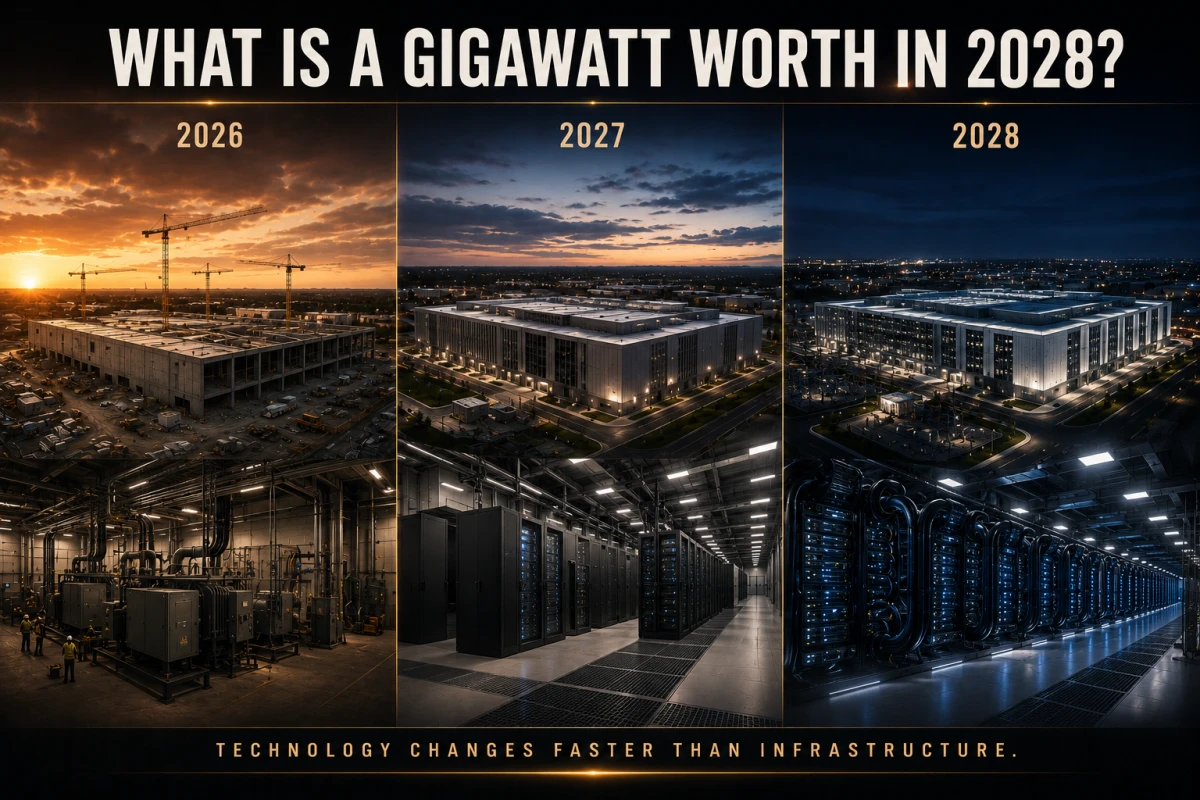
2028 is a long time in AI
Two years is not particularly long when constructing substations or transmission infrastructure.
In AI hardware, it can represent a dramatically different economic environment.
NVIDIA says Vera Rubin NVL72 can deliver up to 10 times more tokens per megawatt than GB200 NVL72 and approximately one-tenth the cost per million tokens in the specific inference comparisons it publishes. NVIDIA explicitly notes that the figures depend on the selected workload and benchmark conditions.
That does not mean future AI will require one-tenth as much data-center infrastructure.
Efficiency can lower prices, expand use cases and stimulate enough additional demand to increase total compute consumption.
But it illustrates why raw gigawatts tell only part of the story.
The economically important question is closer to:
How much useful AI output can each megawatt produce — and at what cost?
That relationship can change substantially between the moment a project is financed and the moment it becomes operational.
A facility scheduled for 2028 is therefore not only competing with other facilities.
It is competing with the economics of technology that may not yet exist when today's investment decisions are made.
Scenario One: demand absorbs everything
The first scenario is the most bullish.
AI demand continues growing faster than infrastructure can be built.
SpaceX brings several gigawatts online.
Ohio comes online.
Hyperscalers continue expanding.
Efficiency improvements reduce the cost of AI, which creates still more applications and greater demand.
In that world, the biggest problem may remain too little infrastructure rather than too much.
The primary risks are execution risks:
Can power arrive quickly enough?
Can hardware be delivered?
Can facilities be built and commissioned on schedule?
Can utilization remain high?
If the answer is yes, several apparently competing projects could all succeed simultaneously.
Scenario Two: infrastructure outruns demand
Now change one assumption.
The projects work.
They simply work faster than customer demand grows.
SpaceX, OpenAI, hyperscalers and other infrastructure providers bring enormous quantities of compute online.
Customers gain negotiating power.
Compute pricing changes.
Flexible contracts become more valuable.
Utilization becomes more important.
But long-lived infrastructure still carries financing, energy, maintenance and capital costs.
Then the central question changes from:
Can we build enough?
to:
Who accepted the demand risk?
The AI customer?
The infrastructure owner?
The equity investor?
The lender?
The hardware supplier?
The guarantor?
That is where clauses which currently look like contractual details can suddenly become financially important.
Scenario Three: technology changes the unit of value
The third scenario does not require weak AI demand at all.
AI could become far more valuable and widely used.
But hardware, model architecture and software optimization could still change the economics of infrastructure.
If future systems produce dramatically more useful AI output from the same power envelope, then a gigawatt of capacity in 2028 may have a very different economic meaning from a gigawatt in 2026.
That can be positive.
It can increase output enormously.
But technological transitions also alter residual values, upgrade requirements and the relative attractiveness of different generations of installed hardware.
The market may gradually stop asking only:
How many gigawatts do you have?
and increasingly ask:
What economic value can each gigawatt produce?
The biggest risk does not require an AI crash
This may be the most important distinction in the entire discussion.
The AI infrastructure boom does not have to collapse for individual investments to disappoint.
AI can become one of the most important technologies in the world while some AI infrastructure projects still turn out to have been financed at the wrong price, constructed on the wrong timetable or built around assumptions that later changed.
Those ideas are not contradictory.
The internet transformed the global economy.
That did not make every telecom network, fiber buildout or technology investment made during the internet boom a good investment.
Industrial transformations create extraordinary winners.
They can also create capital misallocation.
The larger this investment cycle becomes, the more important that distinction is.
Where are the shock absorbers?
That leads to the real purpose of the stress test.
Not:
Which company will fail?
But:
Where does the financial shock stop if one assumption fails?
Consider the chain:
AI demand → compute → data centers → power → leases → project finance → guarantees → capital markets
A change can begin almost anywhere.
A customer leaves.
A project is delayed.
Power costs change.
Compute prices soften.
A new hardware generation alters economics.
Credit becomes more expensive.
Residual values fall.
None of those developments automatically creates a crisis.
But an infrastructure system financed around several optimistic assumptions can become much more sensitive when two or three variables move simultaneously.
A contract does not make risk disappear.
It determines where the risk moves.
The real race is between assumptions and reality
It is tempting to frame this as Elon Musk versus OpenAI.
That is too simple.
It is not really SpaceX versus Ohio either.
The deeper competition is between different infrastructure strategies.
One emphasizes massive long-term commitments.
Another emphasizes construction speed and commercial flexibility.
SpaceX is even exploring a third model: orbital AI compute. Its SEC filings say the company expects deployment could begin as early as 2028, while simultaneously warning investors that scaling such infrastructure involves substantial technical and commercial uncertainty.
All of these strategies depend on assumptions about power, hardware, customers, financing and the future economic value of AI.
Some assumptions will prove conservative.
Some will be correct.
Others will not survive unchanged.
And that is when we will discover which contracts mattered, which guarantees mattered — and where the financial risk had actually been sitting all along.
AI factories are being built now.
The stress test comes later.
💬 What do you think?
AI infrastructure is expanding before many of its long-term economics have been tested.
If capacity grows dramatically over the next two years, what becomes the greater risk — failing to build enough compute, or building too much before the market knows what that compute will ultimately be worth?
Share your view in the comments.
Stress-Testing the AI Race: Questions and Answers
Vad är din reaktion?
 Gilla
0
Gilla
0
 Ogilla
0
Ogilla
0
 Kärlek
0
Kärlek
0
 Rolig
0
Rolig
0
 Wow
0
Wow
0
 Ledsen
0
Ledsen
0
 Arg
0
Arg
0

Hej, jag heter Staffan Carlsson
Jag är grundare och ansvarig utgivare för NextNet.se – en svensk nyhetsplattform med fokus på artificiell intelligens, teknik, cybersäkerhet och digital innovation.
Varför NextNet?
Jag startade NextNet med målet att skapa en modern och lättillgänglig nyhetssajt där teknik och AI står i centrum. Den tekniska utvecklingen går snabbare än någonsin, och jag tror att det är viktigare än någonsin att kunna förstå vad som händer – utan att behöva vara expert.
Genom NextNet vill jag lyfta fram nyheter, analyser och trender som hjälper läsare att navigera i en allt mer digital värld.
Mitt teknikintresse
Teknik har varit en stor del av mitt liv under många år. Jag fascineras av hur innovation, internet och artificiell intelligens förändrar sättet vi arbetar, kommunicerar och bygger framtidens samhälle.
Utöver arbetet med NextNet ägnar jag mycket tid åt webbplattformar, servermiljöer, AI-lösningar och digitala projekt där nyfikenhet och lärande alltid står i centrum.
Min vision
Jag vill att NextNet ska vara en trovärdig och inspirerande källa för alla som vill följa utvecklingen inom AI, teknik och digitalisering – oavsett tidigare kunskapsnivå.
AI-drivna nyheter för en digital värld.











Kommentarer (0)