
AI Saves Time – So Why Don’t We Get It Back?
In a European Commission survey, people who use AI at work report saving time. Companies are planning for greater capacity, while governments are focusing on skills and transition. But when the same work takes less human time, a harder question remains: who gets the value of the time saved?
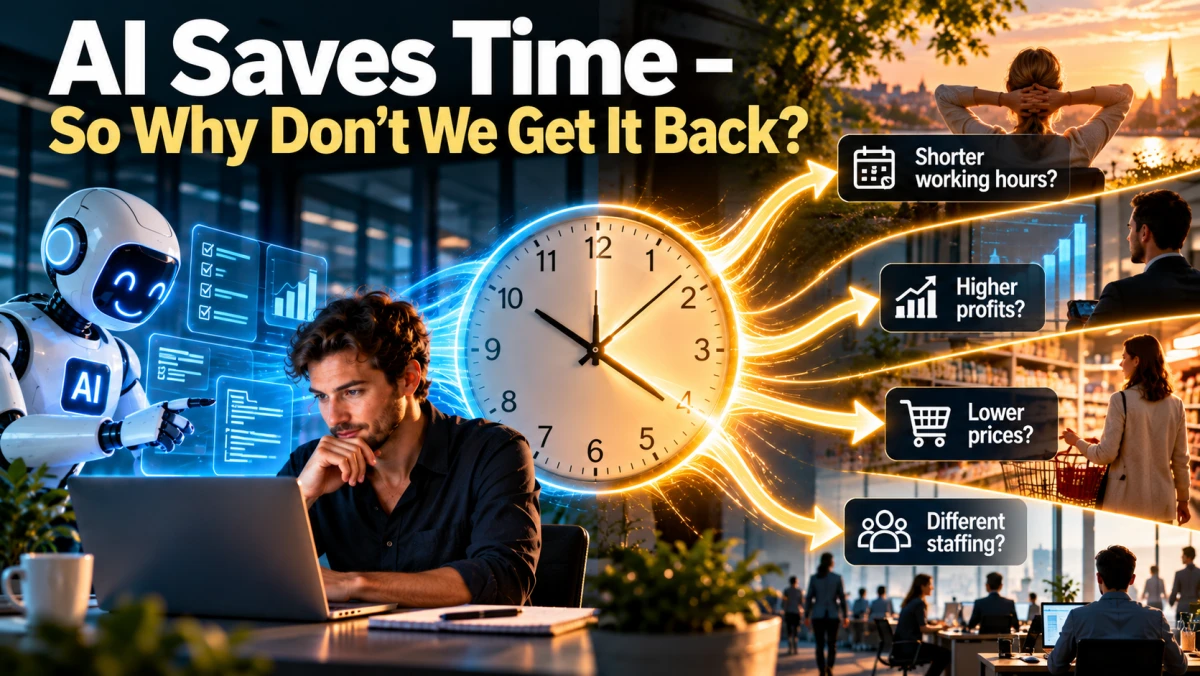
AI can already save time on some work tasks. But when work moves faster, technology does not answer what happens to the time left over.
Saved time is not automatically a shorter workday, higher pay or greater job security. It can become more output, lower costs, lower prices, higher profits, higher pay, shorter hours or different staffing. That is why the AI productivity debate is not only about how much more can be produced. It is also about who captures the value.
What matters most
- AI users in the European Commission survey report time savings at work.
- A productivity gain has no automatic distribution mechanism.
- The reviewed company and government documents focus mainly on productivity, skills and transition.
- In the reviewed material, no established model for directly sharing AI productivity gains through working time, pay or profit-sharing could be verified.
AI Is Already Saving Time
In the European Commission’s Consumer Surveys, 91% of people using AI at work said they complete work faster. Among those reporting savings, the average estimate was 7.4 working hours a month. These are self-reported data, not measured productivity; the voluntary survey covered 18 EU countries representing 69% of the EU population.
The ILO review finds productivity gains that are real but uneven. Reported time savings have not yet clearly translated into higher measured output, income or employment.
A task completed faster does not automatically create time that can be used elsewhere. Firm-level productivity also depends on workflows, coordination, quality, demand and how work is organised. Higher output or income are further steps, not automatic consequences of completing a task faster.
A Productivity Gain Has No Automatic Owner
A faster task can create room for shorter hours, higher pay, more output, lower prices, higher profits, returns to capital or different staffing. This is an analytical framework, not a claim that one result already dominates. The Conference Board describes an “AI dividend” and says work design affects distribution among investors, customers and employees; it is not proof of a universal observed outcome.
Several groups can benefit at once. A company may invest part of a gain or lower costs; workers may receive pay or time; customers may receive lower prices or better services; capital owners may receive returns; society may be affected through taxes, public services or demand. Distribution is not necessarily zero-sum, but neither is it automatic.
Companies Are Planning for More Capacity
NVIDIA’s State of AI Report 2026 says 53% of its respondents named improved employee productivity among the largest effects. It is NVIDIA’s own selected survey, not independent labour-market data. Microsoft’s Work Trend Index reports that 33% of leaders say they are considering reducing headcount, 78% say they are considering hiring for new AI roles, and 82% expect digital labour to expand workforce capacity within the next 12–18 months. These are plans and expectations, not observed layoffs or guaranteed outcomes.
OpenAI says some jobs may disappear while proposing training, certification, matching, transitions and AI Talent Hubs. A separate survey of 81,000 Claude users, linked to Anthropic’s Economic Index, records self-reported productivity gains. It also finds that greater AI exposure is associated with greater concern about job loss. This is neither observed unemployment nor a representative labour-market outcome.
These sources do not provide the same kind of evidence. NVIDIA reflects a supplier’s respondents, Microsoft captures plans and expectations, OpenAI presents workforce proposals, and Anthropic collects users’ reported experience and concern. They can broaden the picture, but they cannot be treated as observed labour-market outcomes.
Governments’ Answer: Train, Reskill, Adapt
The reviewed EU, Swedish, US and UK documents repeatedly focus on adoption, skills, training and transition. The EU’s Quality Jobs Roadmap, Sweden’s AI strategy, the US AI Action Plan and the UK AI Opportunities Action Plan do not automatically answer how a gain is shared.
Planning for skills, reskilling and transition is real. It may help people build capability, change roles and remain connected to work. But transition policy is not the same as a mechanism for distributing the value created when work becomes more efficient.
But Who Gets the Gain?
No generally applied concrete model for directly sharing AI productivity gains through time, pay or profit-sharing was found in the reviewed material. That is a bounded observation, not a claim that no plan exists anywhere.
Six Hours Instead of Eight
Imagine that AI makes it possible to create the same value in six rather than eight hours. This is a teaching scenario, not a forecast or measured outcome. The difference might become time, pay, output, prices, profit or different staffing; none should be assumed.
One outcome is the same pay for six hours. Another is eight hours and more output. A third is six hours and lower pay. A fourth is fewer employees. A fifth is lower prices or better services. Demand, competition and bargaining matter: strong demand can fill time with new work, while weak demand can reduce the hours required. Institutional and commercial decisions shape the outcome.

Time Can Be Negotiated
Sweden’s Unionen IT agreement divides 6.4% between 5.5% wage increases, 0.5% working-time reduction and 0.4% flex pension, including a paid day off in 2026. It is not AI-specific. OECD case studies include maintained pay and avoided closure or relocation, not a formal AI gain-sharing agreement. Eurofound documents governance and consultation, not gain-sharing.
The agreement shows that working time and compensation can both be part of how economic value is negotiated. It does not show that AI finances shorter hours. Likewise, governance can give workers influence over the use of AI without creating direct gain-sharing. No verified AI-specific agreement for direct wage, time or profit-sharing was found in the reviewed sources.

Household Finances Don’t Adjust as Quickly
Fixed costs remain even if work changes. Finansinspektionen describes vulnerability from high debt and small buffers, while the ECB links high housing costs with late-payment risk. AI is not the observed cause; the AI connection is conditional.
Rent or mortgage payments, transport, children, insurance and other fixed costs do not adjust as quickly as a digital task. Debt, savings and liquid buffers mean households have different margins. A conditional loss of work income can therefore affect consumption differently without implying a predetermined social outcome.
When Labour Income Changes, the Effects Go Beyond the Individual
The IMF discusses conditions under which a lower labour-income share can affect the tax base. This is scenario analysis, not a prediction that taxes must rise or demand must collapse.
Labour-income share is, simply, the share of income going to work rather than profit and capital returns. It can affect consumption and aggregate demand, but saving, investment, credit, trade, taxes, transfers, monetary policy and fiscal policy can all change the picture. There is no automatic tax increase, collapse or fiscal crisis.

NextNet Analysis: The Unanswered Question
NextNet Analysis: AI can change how much human time is needed to create value. It does not decide on its own who receives the value of time saved.
Companies, competition, collective agreements, labour markets, wage-setting, taxes, social insurance and political choices all shape the answer. AI can save time, but saved time is not automatically free time. It can become output, profit, lower prices, higher pay, shorter working time or different staffing.
The question becomes more relevant as tools improve and spread. Asking who gets the time is not denying AI’s potential. It is taking its economic consequences seriously.
💬 What do you think?
If AI makes it possible to do the same work in less time, who should receive the value: the worker, the company, the customer or society?
Share your view in the comments.
📚 Related articles
Frequently Asked Questions About AI, Working Time and Productivity Gains
Vad är din reaktion?
 Gilla
0
Gilla
0
 Ogilla
0
Ogilla
0
 Kärlek
0
Kärlek
0
 Rolig
0
Rolig
0
 Wow
0
Wow
0
 Ledsen
0
Ledsen
0
 Arg
0
Arg
0

Hej, jag heter Staffan Carlsson
Jag är grundare och ansvarig utgivare för NextNet.se – en svensk nyhetsplattform med fokus på artificiell intelligens, teknik, cybersäkerhet och digital innovation.
Varför NextNet?
Jag startade NextNet med målet att skapa en modern och lättillgänglig nyhetssajt där teknik och AI står i centrum. Den tekniska utvecklingen går snabbare än någonsin, och jag tror att det är viktigare än någonsin att kunna förstå vad som händer – utan att behöva vara expert.
Genom NextNet vill jag lyfta fram nyheter, analyser och trender som hjälper läsare att navigera i en allt mer digital värld.
Mitt teknikintresse
Teknik har varit en stor del av mitt liv under många år. Jag fascineras av hur innovation, internet och artificiell intelligens förändrar sättet vi arbetar, kommunicerar och bygger framtidens samhälle.
Utöver arbetet med NextNet ägnar jag mycket tid åt webbplattformar, servermiljöer, AI-lösningar och digitala projekt där nyfikenhet och lärande alltid står i centrum.
Min vision
Jag vill att NextNet ska vara en trovärdig och inspirerande källa för alla som vill följa utvecklingen inom AI, teknik och digitalisering – oavsett tidigare kunskapsnivå.
AI-drivna nyheter för en digital värld.















Kommentarer (0)