
If AI Slows Down, Who Gets Stuck With the Bill?
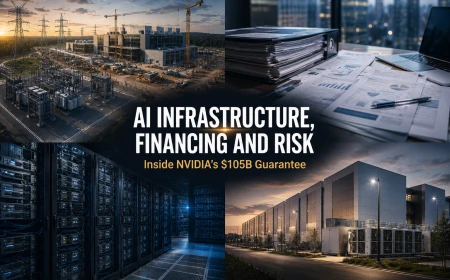
AI infrastructure is being locked into debt, leases, energy contracts and guarantees that may last far longer than the technology they finance. That does not mean the AI buildout is about to slow. But if demand, technology or regulation changes faster than the assumptions behind those commitments, who ends up with the bill?
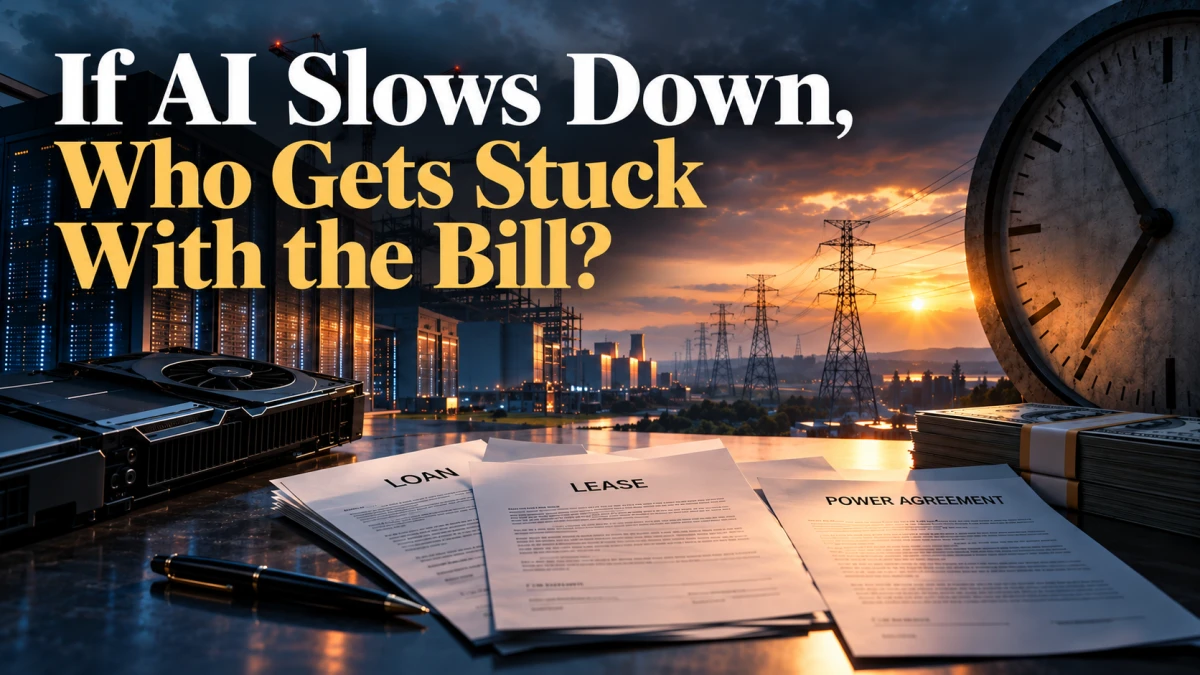
AI can change quickly.
A training project can be paused. Demand for a particular kind of compute can change. Regulation can alter which products may be sold in a market. A new hardware generation can change the economics of the previous one.
But a long-term loan does not disappear because technology changes direction. A 20-year lease does not automatically end because a customer needs less capacity than expected. And a data center that has already been built remains standing even when the assumptions behind it change.
That does not mean the global AI buildout is about to slow. Recent reports from major technology companies instead point to continued large-scale investment and long-term commitments.
But after NextNet's earlier examination of who can actually slow AI down, another question follows.
What happens economically if one of those brakes starts to bite?
If demand grows more slowly than expected, regulation changes, financing becomes more expensive, or technological change makes parts of today's capacity less attractive, who absorbs the loss?
Key takeaways
There is no verified evidence that the broad AI buildout is now stopping. This article is therefore not a forecast of an AI crash.
It examines how economic risk has already been distributed through debt, leases, take-or-pay agreements, guarantees, project companies and long-term energy contracts.
If the assumptions change, there is no universal answer to who takes the loss. In some contracts, the customer may remain obliged to pay. In others, more of the risk may sit with the asset owner, parent company, lenders or investors.
AI may slow down. Contracts do not automatically do the same. Debt does not disappear automatically. Someone owns the asset. Someone holds the loan.
Two clocks moving at different speeds
One striking feature of the AI buildout is the gap between the speed of technological change and the duration of infrastructure finance.
NVIDIA describes a product cycle aimed at introducing advanced data-center architectures roughly once a year. It also warns that faster transitions can make demand harder to forecast and may lead customers to delay purchases as new generations approach. NVIDIA
On the other side are the contracts. As of June 30, 2026, Meta reported about $279 billion in lease commitments that had not yet commenced, mainly for data centers, colocation and network infrastructure, with terms reaching up to 30 years. In July it entered roughly $68 billion in additional data-center leases with terms of 18 to 20 years. Meta
Microsoft reported about $443.5 billion in future operating- and finance-lease payments, including imputed interest, as well as about $194 billion in purchase commitments. The latter relate mainly to data centers and include take-or-pay agreements. Microsoft
Alphabet reported $707 billion in future fixed or guaranteed commitments under long-term supply, energy and other contracts. Its energy agreements run from two to 26 years, in some cases to 2054, and generally include both take-or-pay minimums and significant termination fees. Alphabet
These numbers cannot be combined into a meaningful total. They describe different kinds of commitments and extend beyond AI infrastructure alone. The point is time: technology can change in a year; a contract can live for two decades.
When a working asset can still become stranded
In finance and infrastructure, stranded assets are assets that lose economic value sooner than the assumptions behind them anticipated. An EU definition describes assets or investments that, before the end of their economic life, can no longer generate economic returns because of changes in regulation, markets, technological innovation or other external factors. EUR-Lex
That does not necessarily mean a server, data center or other asset has stopped working. Demand, technology, regulation or the economics around it may instead have changed so much that it no longer produces the value the investment assumed. This article does not say today's AI infrastructure is already stranded; it asks what could happen if economic conditions change faster than assets and contracts can.
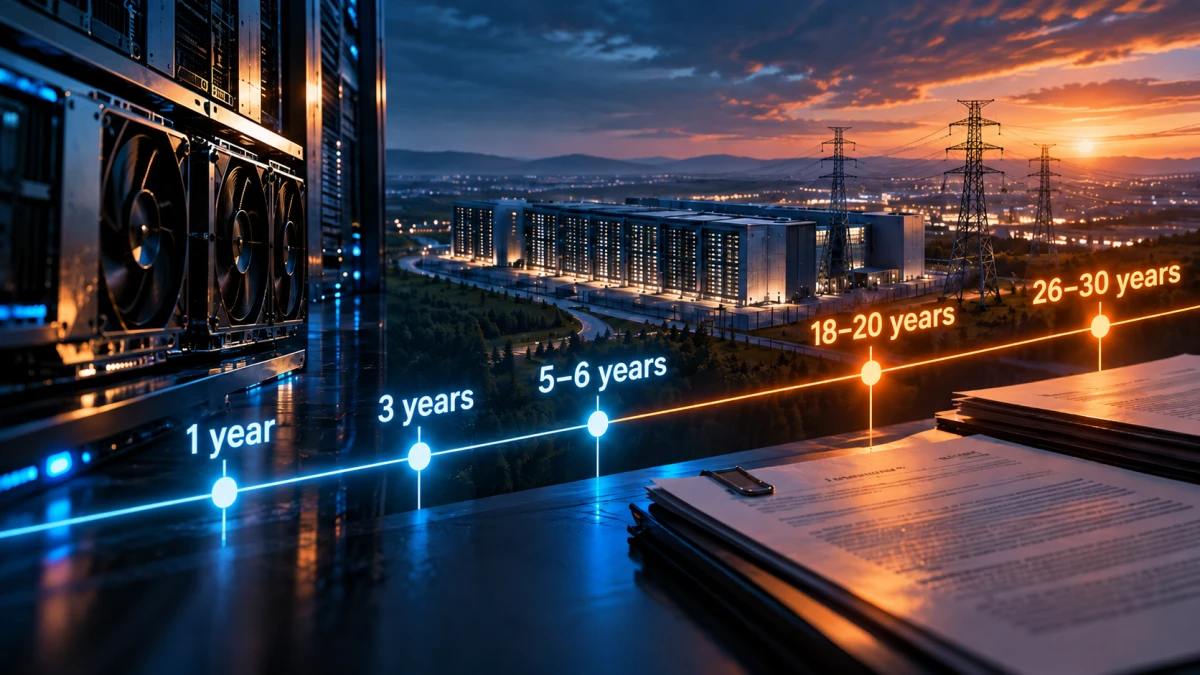
Five time horizons in one system
- About 1 year: NVIDIA's approximate pace for new data-center architectures.
- About 3 years: the average length of the underlying customer contracts behind CoreWeave's DDTL 5.5.
- About 5–6 years: a typical estimated accounting useful life for parts of server and network equipment at several large technology companies.
- 18–20 years: the term of several Meta data-center leases from July 2026.
- Up to 26–30 years: certain Alphabet energy agreements and Meta lease commitments not yet commenced.
None of these horizons is, by itself, evidence of a bad investment. What matters is that they must work together.
How long is five years in AI?
The difference becomes clearer when looking at the servers themselves. Accounting useful life is not physical life. A server may work long after it is no longer optimal for the most demanding AI systems, and it may be moved to other work. But companies still have to estimate how long equipment will provide economic benefit.
Amazon offers an unusually clear example of how difficult that can be. From January 2024, it extended servers' estimated useful life from five to six years. After another review later that year, it decided that from January 2025 it would shorten the useful life of parts of its server and network equipment from six years back to five.
Amazon explicitly cited the faster pace of technological development, particularly in AI and machine learning. In the fourth quarter of 2024 it also recorded about $920 million in accelerated depreciation and related costs after deciding to retire some equipment earlier than planned. Amazon
Meta made a different estimate. From January 2025 it raised the estimated useful life of most server and network assets to 5.5 years. The change reduced 2025 depreciation by about $2.92 billion and increased net income by about $2.59 billion. Meta
That does not mean Amazon or Meta is wrong. It shows that two of the world's largest technology companies can make different judgments, in the same AI race, about how long their equipment should be used economically - and that those judgments can affect reported results by billions of dollars. It is an estimate of the future. And the future moves quickly.
New technology does not make old technology worthless
There is an important counterpoint. An older GPU does not automatically become worthless when NVIDIA releases a new generation. It may still be used for inference, less demanding models, research, simulation or other workloads that do not require the latest hardware.
In its own risk reporting, CoreWeave says it seeks to maximize the value of existing infrastructure by repurposing components after their original contract period. It also warns that useful-life estimates may prove wrong and that redeployment may not always be economically successful. CoreWeave
CoreWeave has shown investors examples of A100 capacity - based on an NVIDIA architecture introduced in 2020 - contracted into 2029, as well as renewed H200 capacity. CoreWeave That is company evidence, not independent proof of how the whole market works. It does show why the claim that each new GPU generation automatically makes the previous one economically worthless is too simple.
The relevant question is what economic value older capacity can still produce compared with the value investors assumed when it was bought.
Contracts can shift the loss
It is easy to assume that weaker demand would automatically hit the company that built the data center. It need not work that way.
In November 2025, Nebius entered a five-year agreement with Meta for dedicated GPU capacity. It includes long-term commitments for the contracted capacity, specified service levels, service credits and rights to terminate individual portions under certain delivery or availability conditions. Nebius
A larger March 2026 arrangement also contemplates Nebius selling some GPU capacity to other customers. If it is not sold, Meta is obligated under the agreement to buy the unsold capacity for the rest of the five-year period. Nebius
That does not mean Meta is bound whatever happens: the agreements contain conditions, service levels and termination rights. But they illustrate the principle. A contract can shift demand risk. If a customer uses less capacity than expected but must still pay under its terms, the supplier may be relatively protected during the contract. When it ends, the allocation can change again.
When the loan outlives the customer contract
CoreWeave provides a concrete next step. In August 2026 it raised a roughly $2.6 billion facility, DDTL 5.5, to finance GPU servers and related infrastructure for customer contracts. The facility runs for about five years. The underlying customer contracts have an average length of about three years.
CoreWeave describes this as evidence of lenders' confidence in long-term GPU demand, saying they are willing to “underwrite renewal risk”: finance the period in which today's customer contracts must be renewed or replaced. CoreWeave
That is CoreWeave's own description of the financing. Lenders are not financing only contracted cash flow through the end of the loan; part of the model assumes capacity can later be renewed, redeployed or sold to other customers. That does not mean something will go wrong. It means someone has accepted the risk that future demand must be there when current contracts expire.
Who bears the loss when something goes wrong?
In a conventional capital structure, equity normally acts as the first economic shock absorber when a project loses value. Owners' equity can fall or disappear before secured lenders necessarily need to write down their claims. But once a project has payment problems or defaults, recovery depends on collateral, priority, guarantees, cash flows and the specific credit agreements.
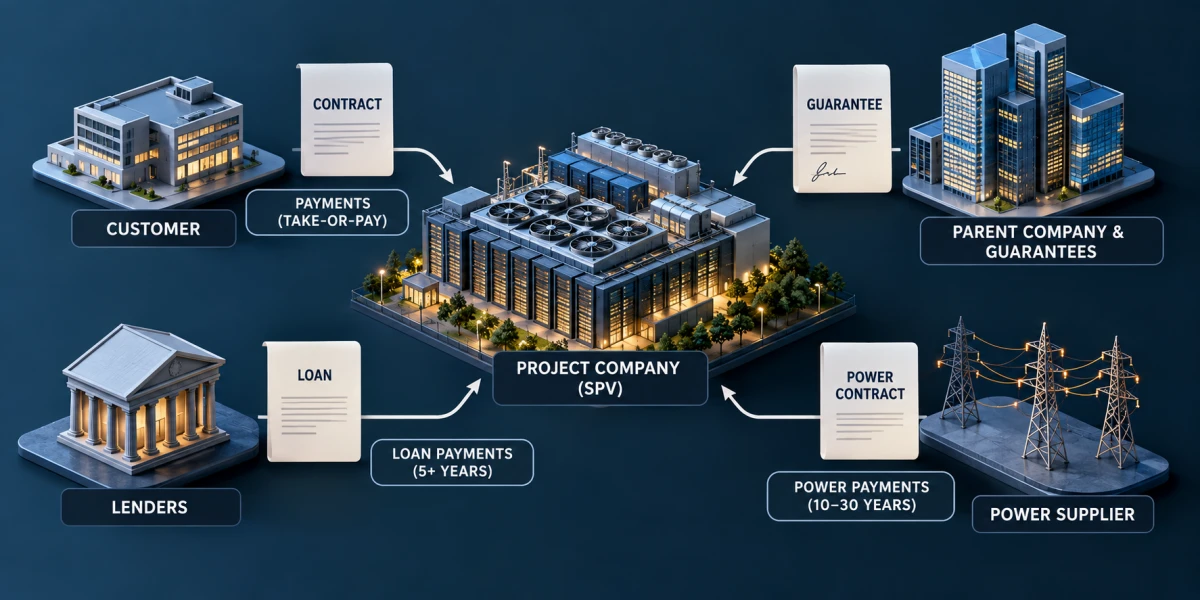
CoreWeave uses several financing structures. In March 2026, a subsidiary established DDTL 4.0, a facility of up to $8.5 billion. It is largely non-recourse to the parent, apart from limited guarantees for specified exceptions; lenders instead have first-priority security in project-level interests and substantially all assets. CoreWeave
Two months later, another subsidiary established DDTL 5.0 for $3.1 billion. Those obligations are unconditionally guaranteed by CoreWeave and by borrower subsidiaries, with broad security over borrower and subsidiary assets. CoreWeave DDTL 5.5 also has an unconditional parent guarantee and extensive security. CoreWeave
The answer can therefore differ even within one company. In a non-recourse structure, lenders may be mainly limited to project cash flows and collateral. With a parent guarantee, there is another party against which claims may be made. There is no universal answer that the bank takes the loss or the AI company takes it. Contract structure determines who stands closest to the hit; capital structure determines how the decline in value is distributed.
An SPV does not make the risk disappear
The Bank for International Settlements describes more AI infrastructure being financed through joint ventures and special purpose vehicles. An SPV may own or develop a data center and borrow from private-credit funds and institutional investors while a hyperscaler owns a minority position, signs long-term leases or capacity contracts, and sometimes provides guarantees.
BIS calls parts of this shadow borrowing: obligations that resemble debt but largely sit outside a technology company's balance sheet. Banks may finance the vehicles that finance data centers, creating possible transmission channels through refinancing, private credit and guarantees. Bank for International Settlements
Meta's Louisiana data-center project illustrates the point. Meta owns 20% of a joint venture, has about $12.3 billion in initial lease commitments, and residual-value guarantees with an aggregate threshold of about $28 billion. If relevant lease and guarantee conditions are met, it could have to cover part of the difference between asset value and the threshold. Meta says such payments are not currently considered probable. Meta
Moving an asset into a separate vehicle does not automatically remove economic exposure from the customer or technology company.
When the power contract outlives the GPU
The mismatch in time becomes sharper here. NVIDIA describes roughly annual architecture cycles. Amazon uses estimated useful lives of around five to six years for server and network equipment; Meta uses about 5.5 years for most comparable assets; Microsoft reports a two-to-six-year range. Alphabet, meanwhile, has energy agreements running for up to 26 years. Alphabet
That does not make long contracts inherently wrong. Data centers can support several hardware generations, electricity remains useful regardless of the GPU in the rack, and infrastructure can be upgraded and reused. But the long-term calculation depends on sufficient economic value continuing to exist. What happens if technological or commercial conditions change faster than the contracts can?
Regulation can change the economics quickly
A new GPU generation is not even required for the economics to change.
In fiscal 2026, NVIDIA recorded about $7.2 billion in provisions for inventory and excess purchase obligations. About $4.5 billion related to H20 after US export restrictions reduced available demand in China. NVIDIA
This is not evidence that the global AI buildout has slowed. Nor is it an example of technical obsolescence.
It is something more useful for this analysis: a concrete example of regulatory change quickly affecting the economics of already planned inventory and purchase commitments.
Could ordinary electricity customers end up with part of the bill?
AI infrastructure does not end at the data-center wall. It also requires generation, transmission and other grid infrastructure.
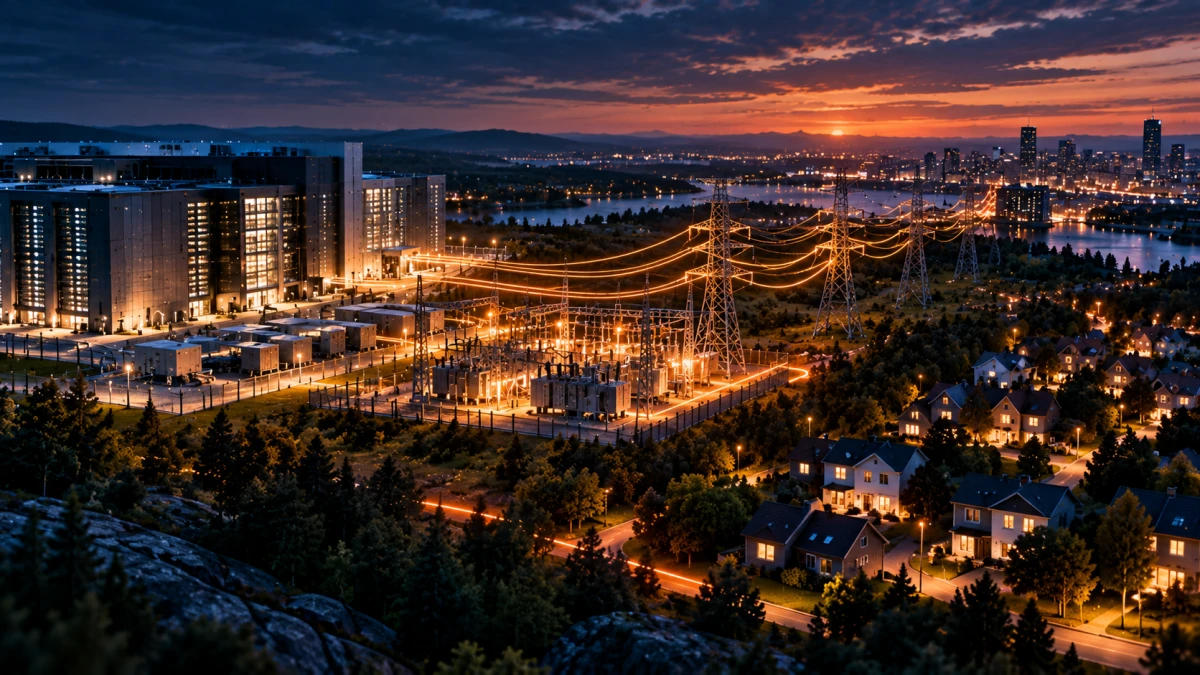
Virginia's State Corporation Commission has therefore created a special customer class for very large electricity users, including hyperscale data centers. Its stated purpose is to reduce the risk that the costs of rapid expansion are shifted to other customers.
The rules include a minimum 14-year commitment for electric service and a requirement that large customers pay at least 85% of certain transmission and distribution costs regardless of actual usage. Customers with insufficient creditworthiness may also have to provide security for up to 60% of minimum costs. Virginia State Corporation Commission
That does not mean US households will pay for a future AI slowdown. On the contrary, the rules exist precisely to reduce that risk. But putting such protections in place shows that the regulator considers cost shifting a risk worth addressing.
Virginia has also examined what could happen if utilities build new infrastructure for a very large projected data-center load that later does not materialize. JLARC points to the risk of stranded costs that may have to be recovered from the existing customer base if rules and contracts do not adequately protect other customers.
JLARC describes a second, distinct mechanism: even when data centers pay their direct share of infrastructure, their aggregate demand can raise system costs and electricity-market prices, affecting other customers. Virginia JLARC
Those are not the same thing. Direct cost shifting from a specific data center is one question. Higher electricity prices in a system with sharply rising demand are another.
What about taxpayers?
The public sector also makes economic calculations around data centers.
Since 2010, Virginia has used a sales-and-use-tax exemption to attract large data centers. In fiscal year 2023, qualifying firms and their tenants reported about $928.6 million in tax savings through the program. JLARC also reports positive economic effects from the industry, particularly during construction, and meaningful local tax revenue in some places. Virginia JLARC
That does not mean taxpayers automatically absorb a future AI loss. The public sector gives up some revenue in exchange for expected capital investment, jobs and future economic activity.
If the assumptions change, however, there is also a public question: did the long-term public benefit match the assumptions behind the policy?
Money itself can become the brake
In January 2026, the Bank for International Settlements assessed the then-current macroeconomic and financial-stability risks from the AI boom as moderate. At the same time, it said investment needs had become large enough that more financing was coming from debt and private credit, and that the boom's sustainability depends on AI companies meeting high future revenue expectations. Bank for International Settlements
There have since been early signs that the bond market is beginning to price AI-related financing more cautiously. On September 22, 2026, Reuters reported that investors were becoming more selective as AI-related corporate debt issuance increased. Goldman Sachs data cited by Reuters put spreads for AI-related investment-grade bonds at around 115 basis points, compared with about 78 basis points for the broader investment-grade market.
Reuters also made an important distinction: the difference was not primarily described as fear that the major technology companies would fail to repay their debt. Investors instead pointed to heavy issuance, concentration risk and uncertainty about the returns massive AI investment will ultimately generate. Reuters
This is not evidence that financing has stopped. It is an early example of how the cost of capital can begin to react. If investors demand higher risk premiums, lenders become more cautious or expected returns fall, financing new projects can become more expensive. Money itself can then begin to act as a brake.
Counterargument: what if everything goes according to plan?
That possibility also needs to be stated plainly.
There is a fully plausible scenario in which today's large investments prove rational. Demand for AI capacity may keep growing. Older GPUs may find new customers and use cases. Data centers may be upgraded generation after generation. Long energy contracts may provide stable power for a growing business. AI revenue may grow fast enough to support the investments. Lenders may be repaid, and investors may receive their expected returns.
The material reviewed by NextNet does not show that this scenario is unlikely. It also does not show that a broad AI stop or a financial crisis is coming.
That is why this article begins with if.
NextNet analysis: the biggest risk may be the mismatch in time
From this point, we leave the verified factual record and move into NextNet's analysis.
The most striking feature is not any single billion-dollar figure. It is the mismatch in time.
Technology companies must make decisions now about server useful lives years ahead. Lenders finance GPU capacity beyond some of the customer contracts behind those loans. Data-center leases can run for one or two decades. Energy agreements can last longer still. Yet AI hardware, regulation, model architecture and competition change much faster.
That need not be a problem if demand continues to grow and infrastructure can be reused. But it means a large part of the AI economy rests on long-term financial decisions around technology whose future cost, performance, use and regulation are difficult to predict far ahead.
Risk does not disappear when it moves off the balance sheet.
It changes hands.
Take-or-pay can shift risk from supplier to customer. An SPV can move debt outside a hyperscaler's balance sheet. A guarantee can shift part of the risk back. Secured financing can leave lenders exposed if collateral value is insufficient. Electricity and infrastructure systems need rules if broader cost spreading is to be limited.
None of that predicts failure. It shows that the system has already become much more complex than the question of who owns a GPU.
So who gets stuck with the bill?
The answer is not one company, one bank or one investor.
It depends on the contract.
And on the capital structure.
If demand falls while a take-or-pay agreement still applies, the customer may keep paying. Once the customer contract expires, risk may move toward the data-center operator and asset owner. If a project's value falls, owners' equity normally acts as the first economic shock absorber. If the debt then defaults and is non-recourse, lenders may depend heavily on the project's assets and cash flows. If a parent has provided a guarantee, there is another layer against which claims may be made.
If GPUs can still be rented out, much of their value may remain. If their economic value falls sharply, the calculation changes. If the energy system is expanded for demand that later does not materialize, regulators must decide how costs are allocated. And where public incentives have been used, there is also a broader economic calculation for the public sector to evaluate.
None of these mechanisms proves that the AI buildout will slow. But they show why the question matters before we know whether it will.
The AI industry is not only building models and data centers. It is also building a web of contracts, loans, guarantees, energy commitments and financial connections around the technology. If the technology keeps growing at the pace today's investments assume, that structure may work exactly as planned. But if one of the underlying assumptions changes, the cost does not simply disappear.
Someone still owns the asset.
Someone still holds the loan.
Someone still signed the contract.
AI may be able to slow down quickly.
The financial system built around it may not be able to do so as quickly.
💬 What do you think?
If the AI buildout were to slow sharply at some point, who should bear the economic risk: the companies that ordered the capacity, the investors who financed it, or someone else?
Share your view in the comments.
📚 Related articles
Vad är din reaktion?
 Gilla
0
Gilla
0
 Ogilla
0
Ogilla
0
 Kärlek
0
Kärlek
0
 Rolig
0
Rolig
0
 Wow
0
Wow
0
 Ledsen
0
Ledsen
0
 Arg
0
Arg
0

Hej, jag heter Staffan Carlsson
Jag är grundare och ansvarig utgivare för NextNet.se – en svensk nyhetsplattform med fokus på artificiell intelligens, teknik, cybersäkerhet och digital innovation.
Varför NextNet?
Jag startade NextNet med målet att skapa en modern och lättillgänglig nyhetssajt där teknik och AI står i centrum. Den tekniska utvecklingen går snabbare än någonsin, och jag tror att det är viktigare än någonsin att kunna förstå vad som händer – utan att behöva vara expert.
Genom NextNet vill jag lyfta fram nyheter, analyser och trender som hjälper läsare att navigera i en allt mer digital värld.
Mitt teknikintresse
Teknik har varit en stor del av mitt liv under många år. Jag fascineras av hur innovation, internet och artificiell intelligens förändrar sättet vi arbetar, kommunicerar och bygger framtidens samhälle.
Utöver arbetet med NextNet ägnar jag mycket tid åt webbplattformar, servermiljöer, AI-lösningar och digitala projekt där nyfikenhet och lärande alltid står i centrum.
Min vision
Jag vill att NextNet ska vara en trovärdig och inspirerande källa för alla som vill följa utvecklingen inom AI, teknik och digitalisering – oavsett tidigare kunskapsnivå.
AI-drivna nyheter för en digital värld.














Kommentarer (0)