
When Google Stops Being Google
Google Search increasingly answers directly with AI, invites follow-up questions and helps users move forward with a task. As the link moves further from the answer, the relationship between Google, the web and the people who create its content changes.
The Next Shift – Part 1
In The Next Shift, NextNet explores how AI is changing digital functions and institutions that have long seemed self-evident — from search and operating systems to apps, the web and the roles of technology companies.
In Part 1, we look at what happens when the world's best-known search engine starts answering, reasoning and acting rather than primarily pointing the way forward.
Google has been easy to understand. You type a question, get a list of links and choose where to go. Search is a signpost: question → links → website.
That is still an important part of the service. But it is no longer the whole picture. With AI Overviews and AI Mode, Google can instead assemble an answer directly on the results page, invite follow-up questions and, in some cases, help the user move forward with a task. The possible sequence becomes: question → AI answer → follow-up question → possible action → possible link.
This does not mean Google has stopped being a search engine. Nor does it mean links have disappeared or the open web has already been replaced by a chat. But it changes the relationship between the search query, the answer and the website that was once the obvious next step.
The Google we knew was a route to the web
Google's basic idea has long been simple: organise information on the web so people can find it. Rankings have always been governed by Google's systems and criteria, but the user's role has been clear. The results page offered options, and anyone who wanted to know more clicked through to a newspaper, a public authority, a shop, a forum or an expert's site.
That created a practical exchange. Google made the web searchable. Websites could gain visibility, readers and sometimes customers in return. For publishers, search traffic has therefore been more than a metric: it has been part of the infrastructure for reaching an audience.
AI does not necessarily change that relationship overnight. But it can shift the centre of gravity. If users get a sufficiently good summary in Google, the link becomes an invitation to explore further rather than the primary route to an answer.
Google is rebuilding Search
AI Overviews are the AI-generated summaries that can appear alongside conventional search results. AI Mode goes further. Google describes it as its most advanced AI search experience: a question can be broken into subtopics, several searches can run simultaneously, and results are assembled into an answer with links back to the web.
This is a different kind of interface from the classic results page. A question no longer needs to be short and narrowly defined. It can be followed up, clarified with an image, file or video, and developed through a conversation. A user who previously needed several searches can instead stay within a continuous flow.
Google also describes a direction in which Search can help with more than finding information. Its product communications mention agentic features for finding tickets, monitoring information, contacting businesses and building generative interfaces. Some of these features have been presented as forthcoming or experimental. It is important to distinguish the documented product direction from what is actually available to every user.
For website owners, Google has meanwhile begun separating content controls in a new way. According to Google's documentation, a global control for generative Search features has been available since August 31, 2026. It covers AI Overviews, AI Mode and generative AI features in Discover. A website can exclude its links and content from these features without that choice being used, according to Google, as a ranking or inclusion signal in other parts of Search.
This is not the same as AI training. For training, Google points to the separate Google-Extended token. Google's model thus distinguishes between traditional Search, generative Search results and AI training. This describes Google's current controls — not a universal standard for how the web works.
From answers to action
Perhaps the most interesting shift is not that an answer gets longer. It is what happens after the answer. When a search service can retain context, handle follow-up questions and help users compare options, it can move towards becoming a service that also does some of the work.
Google has demonstrated features in which AI Mode searches through many options for a task and then hands control back to the user to make a choice or purchase on an external website. There is still a link and an external destination. But the link arrives later in the process: after Google has already helped interpret the need, find the options and sort them.

For users, that can be convenient. Someone looking for two tickets, trying to understand a difficult subject or planning a purchase does not have to formulate every sub-question themselves. For websites and publishers, it also raises a bigger question: when does a visitor become a customer, reader or subscriber if more of the selection and summarising happens before the click?
When the link moves into the background
Both the opportunity and the conflict are easy to see. A good AI answer can save time, particularly for a complex question. But if the answer is enough, it can also reduce the reason to leave the results page. That need not mean nobody clicks through. It may, however, change which questions lead to clicks, and when the link matters.

A preregistered US field study with 1,100 participants examined precisely this. The researchers found that an AI Mode-based search flow reduced clicks through to external websites. When they tried removing Google's AI features, outbound clicks also increased.
The findings should be read cautiously. The study is a preprint, its participants were based in the US, and the sample was younger and more highly educated than the US population overall. Google's changes to the technical implementation also complicated the No AI condition: the researchers could hide only about half of the AI Overviews they intended to hide, so they used a specific analytical method for that part. The AI Mode manipulation, by contrast, worked for almost 95 percent of searches and is the stronger part of the experiment.
The study therefore does not establish how all Google users behave, nor does it say that every AI answer takes traffic away from every website. But it provides independent research evidence for a reasonable concern: as search becomes more of a direct answer, the relationship between visibility and visits may change.
Google's counterargument: more questions, more routes onward
Google does not dismiss the importance of the open web. In its AI Mode documentation, the company stresses that answers draw on web information and that users receive links to explore further. When Google does not have sufficient confidence in an AI answer's quality or helpfulness, AI Mode may instead display links, according to the company.
The company also describes AI as a way to get people to ask more questions, and more complex ones. According to Google, Search has reached record usage and AI Mode has surpassed one billion monthly users. These are the company's own figures, not independent traffic research. But they point to Google's central argument: AI can make Search more useful without making the web less important.
That argument is not unreasonable. A new kind of search can create new needs for original sources, deeper reading, purchases and local services. An AI summary may also help a reader discover a question that would otherwise never have led to a search result. But it remains to be seen how that benefit is shared between Google and the organisations whose content helps answer the questions.
Publishers get new controls — and regulators follow
The new controls show that this is not just a technical question. According to Google, a publisher can now opt out of having links and content appear in generative Search features. But that choice does not automatically resolve the economic question of whether it is better to forgo visibility or keep contributing to an answer that may generate few clicks. Google-Extended, meanwhile, concerns AI training rather than the generative Search control.
Google has also introduced a separate Search Console report for visibility in AI Overviews and AI Mode. It shows impressions, not a definitive measure of their value. The report can help a website see that a link was displayed, but it does not itself show how prominent the link was, what text was used or whether anyone clicked.

In the UK, the competition authority CMA has already imposed a specific publisher requirement for Google Search. The requirement is UK-specific. Among other things, it requires Google to give publishers effective controls over how their Search content is used in generative AI, explain that use clearly, provide detailed user-engagement metrics and take reasonable steps to ensure clear attribution and access to the original content.
The EU situation involves several separate processes that should not be conflated. As part of an ongoing regulatory dialogue, the European Commission is monitoring whether the integration of AI Overviews into Google Search complies with the DMA. This is not a final decision on AI Overviews. Separately, an antitrust investigation is examining questions about the use of publishers' online content for AI purposes.
In addition, on July 16, 2026, the Commission adopted a binding DMA decision on Google Search data. The decision concerns data access and competition: Google must enable effective sharing of anonymised Search data with eligible search services, which may include AI chatbots with search functions. That is not the same as a publisher control for AI Overviews.
NextNet already appears in Google's AI results
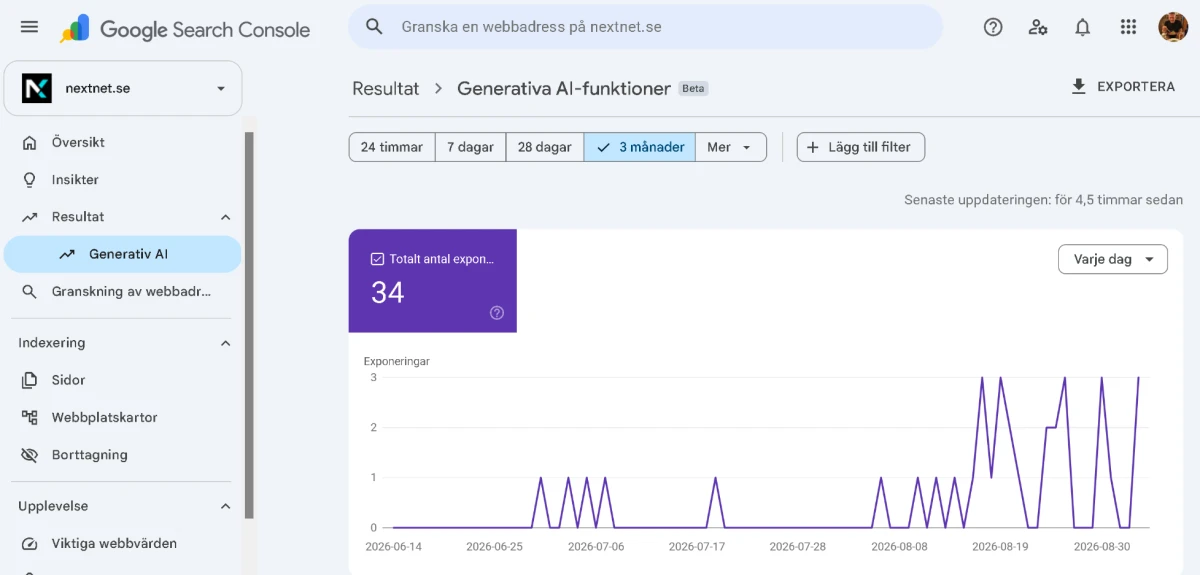
In NextNet's own Search Console check on September 5, 2026, the three-month view showed 34 generative AI impressions.
This is a small first-party observation. An impression means that a link to NextNet was displayed in a generative AI feature. It does not show how prominent the link was, what text Google used, whether the user clicked or how representative the result is of the wider web.
NextNet's analysis: what is Google becoming?
This is analysis. Google may well remain a search engine while the role of search changes. The old model was primarily a route to information. The emerging model may increasingly become a layer that interprets information, keeps the conversation going and sometimes helps users take the next step.
That can make for a better immediate experience. Nobody misses having to run unnecessary searches or open ten tabs to compare the same thing. Google also needs to respond to competition from AI assistants that have already accustomed people to receiving a formulated answer first.
But the model has an inherent tension. Google needs a living web ecosystem with new reporting, expert knowledge, product information and lived experience. Publishers and other websites, in turn, need reasons to keep creating the material that makes search useful. If the AI answer more often becomes the final destination, that relationship may need new forms of attribution, control, measurement and perhaps compensation.
The question is therefore not simply whether Google sends more or less traffic in absolute terms. A more precise analytical question is: can Google get us to search more while a smaller share of each search leads onward to the web? This is not yet an established development. But it is a question that publishers, regulators and Google itself now have to address.
Google may still be Google
Google continues today to display links, index the web and help people find information. That is why the headline should be read as a question, not a verdict.
But as the service moves from primarily pointing the way to information towards increasingly assembling, interpreting and sometimes acting on it for the user, the meaning of a search engine changes. That is where the shift begins: not in the name Google, but in what happens between the question and the click.
💬 What do you think?
When is an AI answer enough for you, and when do you want to click through to the source?
Feel free to share your thoughts in the comments.
📚 Related articles
Vad är din reaktion?
 Gilla
0
Gilla
0
 Ogilla
0
Ogilla
0
 Kärlek
0
Kärlek
0
 Rolig
0
Rolig
0
 Wow
0
Wow
0
 Ledsen
0
Ledsen
0
 Arg
0
Arg
0

Hej, jag heter Staffan Carlsson
Jag är grundare och ansvarig utgivare för NextNet.se – en svensk nyhetsplattform med fokus på artificiell intelligens, teknik, cybersäkerhet och digital innovation.
Varför NextNet?
Jag startade NextNet med målet att skapa en modern och lättillgänglig nyhetssajt där teknik och AI står i centrum. Den tekniska utvecklingen går snabbare än någonsin, och jag tror att det är viktigare än någonsin att kunna förstå vad som händer – utan att behöva vara expert.
Genom NextNet vill jag lyfta fram nyheter, analyser och trender som hjälper läsare att navigera i en allt mer digital värld.
Mitt teknikintresse
Teknik har varit en stor del av mitt liv under många år. Jag fascineras av hur innovation, internet och artificiell intelligens förändrar sättet vi arbetar, kommunicerar och bygger framtidens samhälle.
Utöver arbetet med NextNet ägnar jag mycket tid åt webbplattformar, servermiljöer, AI-lösningar och digitala projekt där nyfikenhet och lärande alltid står i centrum.
Min vision
Jag vill att NextNet ska vara en trovärdig och inspirerande källa för alla som vill följa utvecklingen inom AI, teknik och digitalisering – oavsett tidigare kunskapsnivå.
AI-drivna nyheter för en digital värld.
















Kommentarer (0)