
NVIDIA’s $105 Billion Guarantees - Who Really Carries the Risk?
NVIDIA is investing $1.5 billion in SB Energy and backing OpenAI’s enormous Ohio AI infrastructure project with guarantees capped at $105 billion. The campus is designed to support 8 IT-GW of OpenAI capacity and exclusively host NVIDIA AI compute. As questions about circular financing move into the financial mainstream, the bigger story is how NVIDIA is using its balance sheet to turn future demand for its own technology into financeable physical infrastructure.
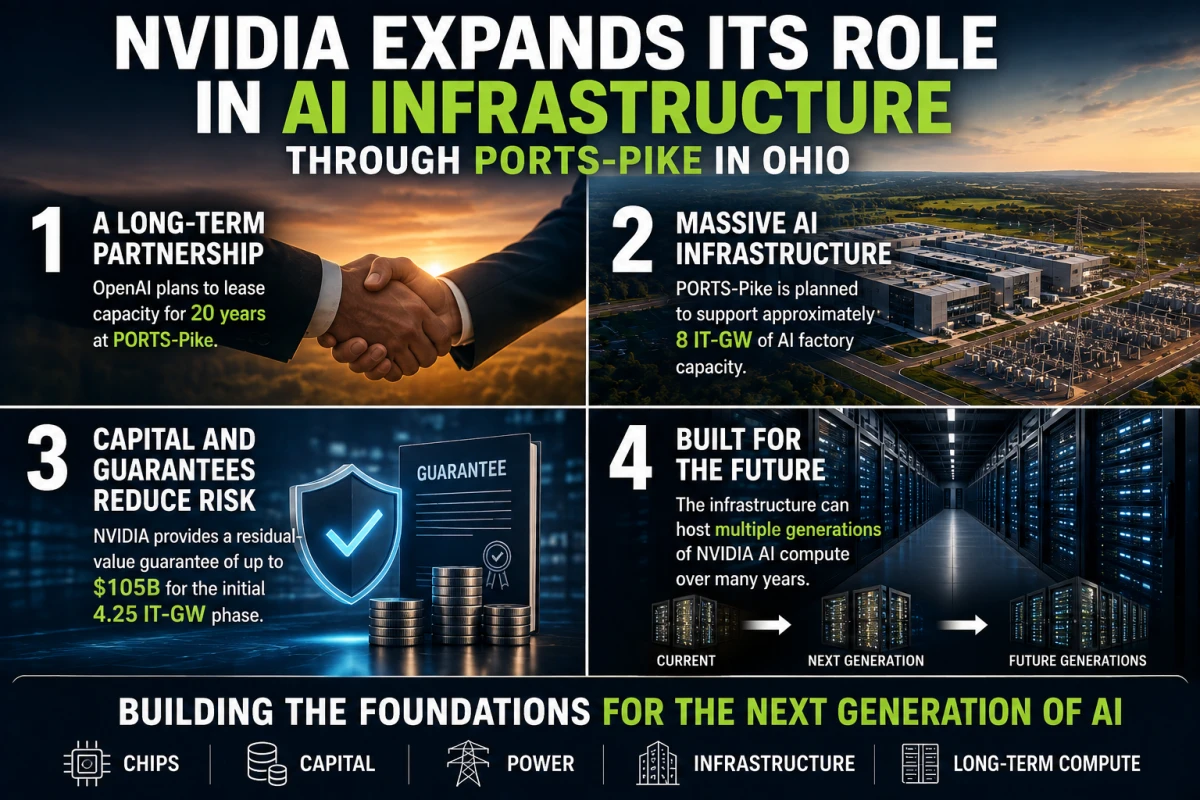
NVIDIA built its position in the AI economy primarily through GPUs and the software and infrastructure platform surrounding them.
Now that role is expanding.
On August 17, NVIDIA announced a $1.5 billion investment in SB Energy, the company developing the massive PORTS-Pike Technology Campus in Ohio. At the same time, NVIDIA entered into a guarantee structure that creates a maximum aggregate exposure of up to $105 billion for the initial phase of the project.
OpenAI will lease the capacity under a 20-year agreement.
But the latest public details make the strategic structure even clearer.
NVIDIA says it will be the exclusive AI compute infrastructure provider at PORTS-Pike. The initial deployment is designed for 4.25 IT-GW, NVIDIA has an option on the remaining 3.75 IT-GW, and OpenAI is expected to be the customer for the full 8 IT-GW of AI factory capacity.
That changes how the transaction should be understood.
NVIDIA is not simply supplying chips to a data center someone else happens to finance.
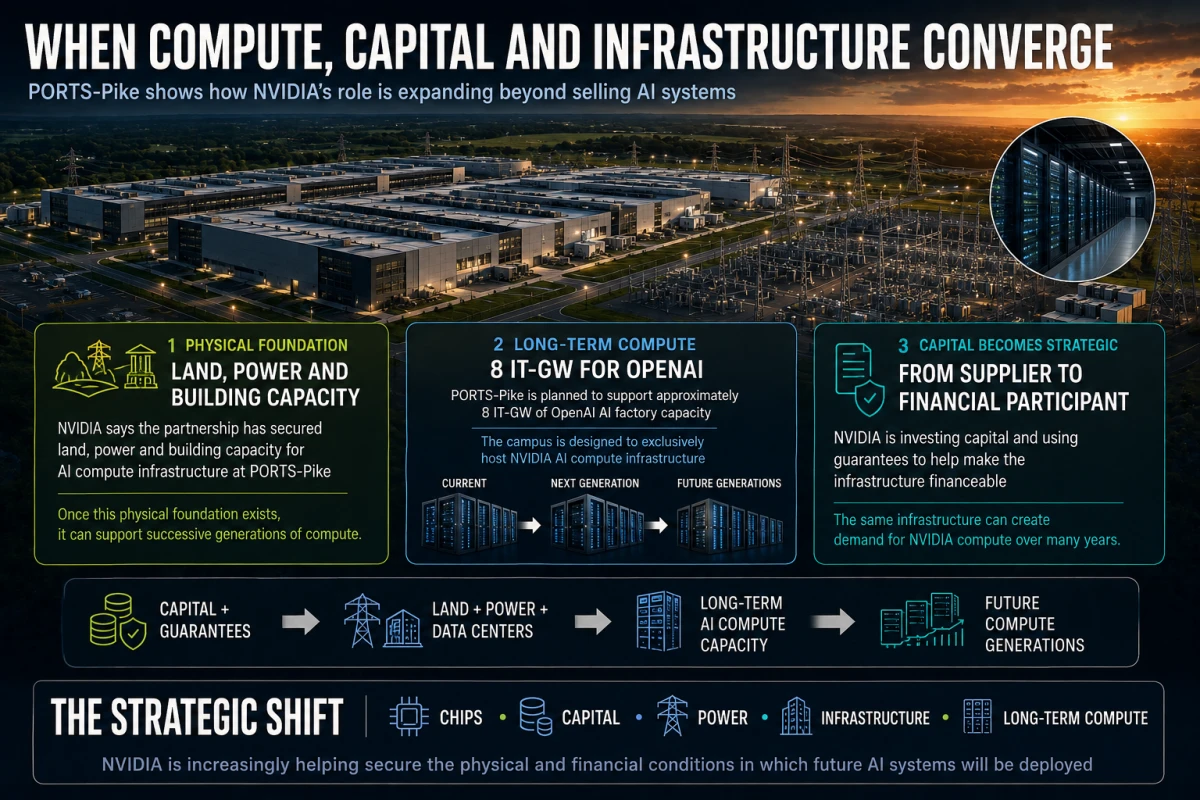
It is investing in the developer, using its balance sheet to support the project, helping secure land, power and buildings — and at the same time securing a massive physical location for NVIDIA compute.
That is a much bigger strategic move.
$105 billion is a ceiling — not a payment
The size of NVIDIA’s guarantee needs to be described carefully.
NVIDIA has entered into multiple residual-value guarantees connected to OpenAI’s leases for the first roughly 4.25 GW of IT load.
The company has not invested $105 billion in the project, nor has it promised to automatically write a $105 billion check if something goes wrong.
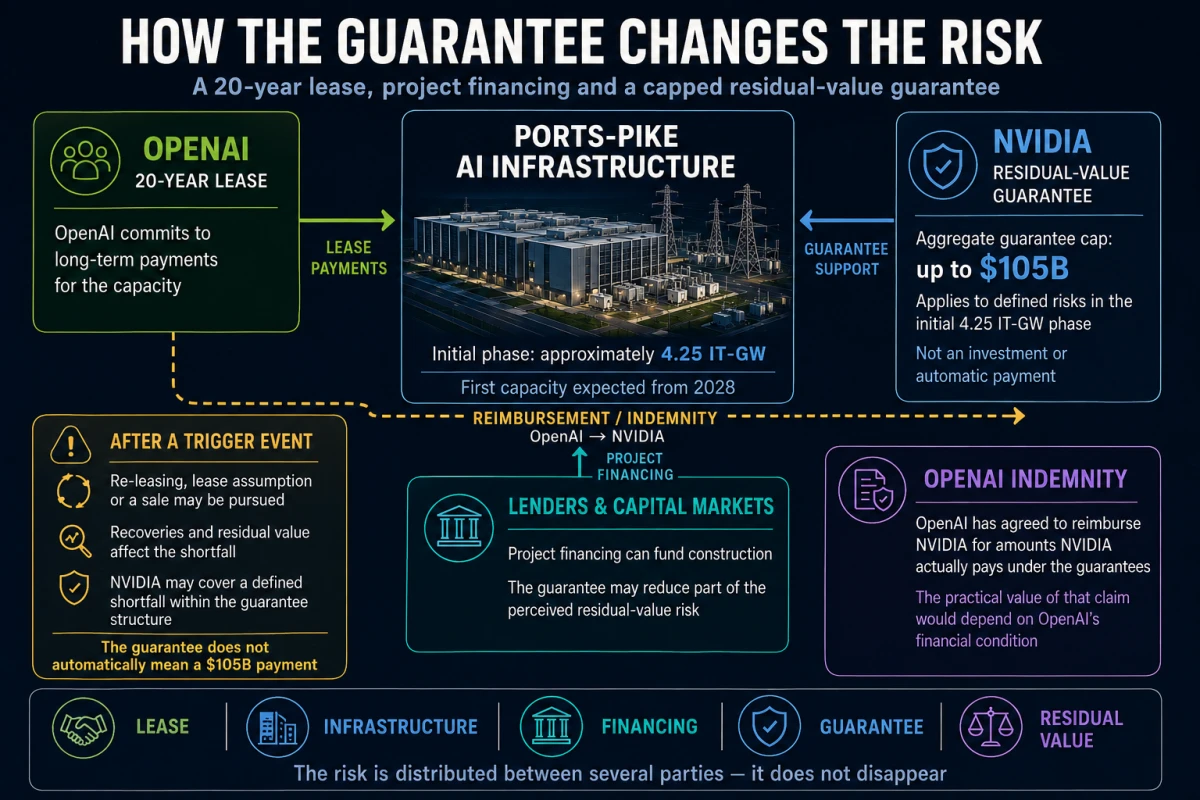
Instead, the aggregate payment obligation under the initial guarantee structure is capped at up to $105 billion. The guarantees become relevant under defined circumstances, including an OpenAI insolvency that results in a lease default or a failure by OpenAI to make required lease payments.
If such a trigger event occurs, NVIDIA could be required to cover a shortfall between a guaranteed minimum value and what SB Energy can recover by re-leasing or selling the infrastructure.
NVIDIA also has several possible remedies. It can, among other things, assume the affected lease, require efforts to find another tenant, initiate a sale or allow the lease to terminate. Certain remedies can be deferred while specified project costs continue to be paid.
The guarantees can also terminate before the full 20-year period under certain conditions, including if OpenAI reaches a satisfactory credit rating.
So the $105 billion figure matters enormously — but it is a maximum contractual exposure inside a defined guarantee structure, not money that has already left NVIDIA’s balance sheet.
NVIDIA has said the form of the underlying agreements will be filed as an exhibit with its upcoming 10-Q. That document will be important because it may provide much more detail about how residual values are calculated, how obligations change over time and what rights NVIDIA has in different default scenarios.
Why 10 GW and 8 GW can both be correct
One source of confusion around PORTS-Pike has been the use of different capacity figures.
Some descriptions refer to a 10 GW campus.
Others refer to 8 IT-GW.
Those figures do not necessarily contradict each other.
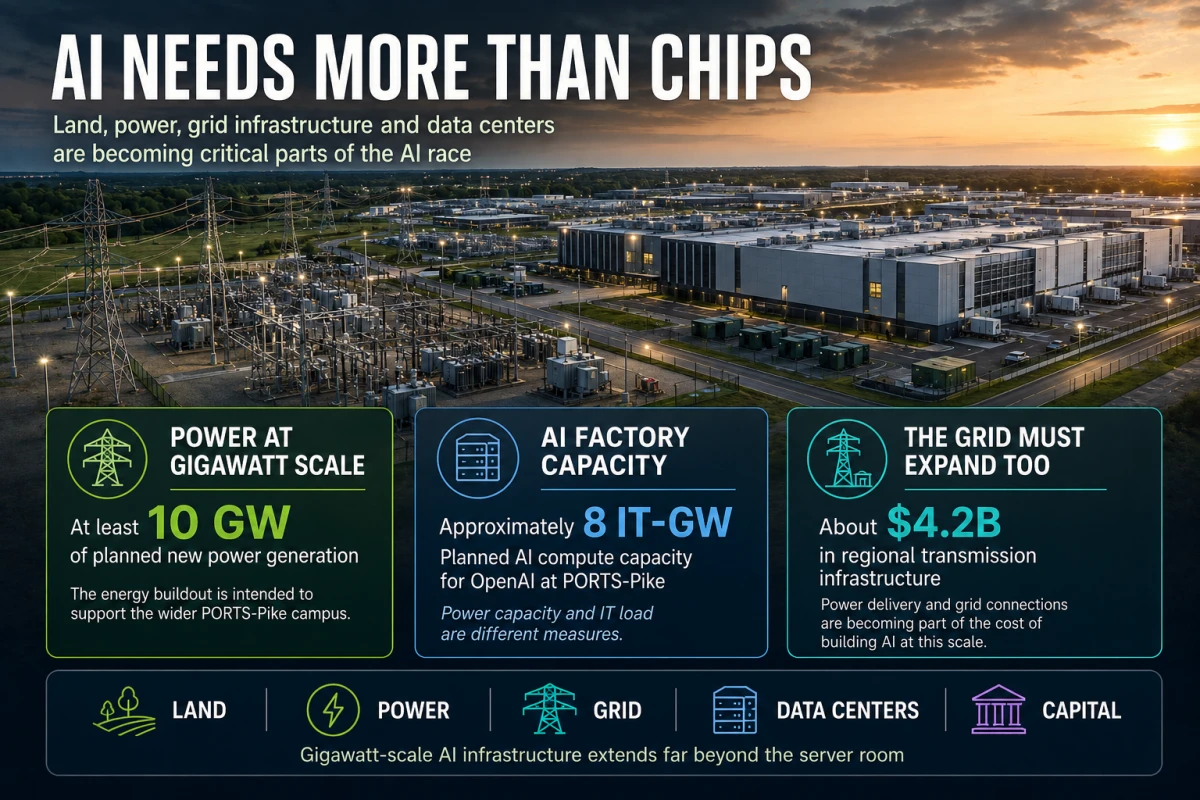
NVIDIA’s own announcement says SB Energy and SoftBank plan to build at least 10 GW of new energy generation, which is expected to support 8 IT-GW of AI factory capacity.
That distinction matters.
Power generation and electrical infrastructure are not the same thing as usable IT load inside a data center.
The project can therefore be described as roughly 10 GW on the physical energy side while supporting around 8 GW of actual IT load for AI compute.
Within those 8 IT-GW, the first phase is 4.25 IT-GW. NVIDIA says it has the option to take the remaining 3.75 IT-GW.
It is a useful reminder of just how enormous the supporting infrastructure behind an AI factory has become.
Up to $200 billion on the other side
The financial logic becomes easier to understand when the potential revenue is considered alongside the risk.
Jensen Huang has estimated that the first 4.25-GW Ohio phase could contribute up to roughly $200 billion in NVIDIA revenue.
That is an estimate, not contracted or guaranteed revenue.
But it puts the guarantee into perspective.
NVIDIA is accepting significant financial exposure around infrastructure that could, if everything goes as planned, become an enormous customer for NVIDIA systems over many years.
And Ohio is only part of the wider OpenAI relationship.
Huang has said OpenAI’s existing and planned commitments represent roughly 12 GW of NVIDIA compute and could eventually reach around 16 GW. At that scale, NVIDIA has estimated a potential roughly $600 billion in compute revenue from OpenAI through 2030.
Again, that is not $600 billion of guaranteed revenue.
But it explains why NVIDIA may be willing to solve problems that once would have been left to customers, banks and data-center developers.
The circular-financing question is now explicit
This is where the story becomes more interesting.
Reuters now explicitly places the Ohio transaction in the wider debate over circular funding flows in AI.
The concern is not that the same dollar literally moves around in a closed circle.
The concern is structural.
NVIDIA uses capital and its balance sheet to make infrastructure easier to finance.
OpenAI leases that infrastructure.
The infrastructure is then filled with NVIDIA compute.
And NVIDIA earns revenue from the resulting demand for its own technology.
Reuters notes that the growing number of interconnected AI deals has already raised concerns about circular financing between NVIDIA and its customers.
Huang rejects that description.
His argument is that NVIDIA is using its scale and long-term visibility into compute demand to help solve one of the industry’s biggest bottlenecks: getting enough infrastructure built.
That distinction matters.
There is nothing inherently improper about a supplier helping customers or infrastructure partners obtain financing.
Equipment manufacturers, property developers and industrial companies have used versions of vendor finance, guarantees and long-term purchase commitments for decades.
But the scale here is unusual.
And so is NVIDIA’s position.
The company is simultaneously a technology supplier, investor, guarantor and strategic beneficiary of the infrastructure being built.
That makes the economics worth following very closely.
Wall Street is starting to split on the risk
The financial market is also beginning to draw a distinction between the size of NVIDIA’s headline commitment and the actual structure of the risk.
Bank of America semiconductor analyst Vivek Arya argues that investors may be overstating NVIDIA’s exposure by treating the $105 billion figure as if it were an immediate or unconditional financing obligation.
The guarantee is much narrower than that. It relates to defined residual-value and lease-related risks and can be triggered only under specific contractual conditions.
Arya therefore views the structure as a calculated use of NVIDIA’s balance sheet rather than an uncontrolled commitment of $105 billion.
That creates an important counterweight to the circular-financing debate.
Critics are asking whether increasingly interconnected investments, guarantees and customer relationships make the AI economy more financially dependent on itself.
The more bullish interpretation is almost the opposite: NVIDIA is using its financial strength strategically to remove infrastructure bottlenecks and secure scarce land, power and data-center capacity that would otherwise be more difficult to finance.
Both views can be true enough to deserve attention.
The real test will not be the headline size of the guarantee, but how much financing it enables, at what cost — and whether the underlying AI infrastructure ultimately generates enough economic value to support it.
How the structure works
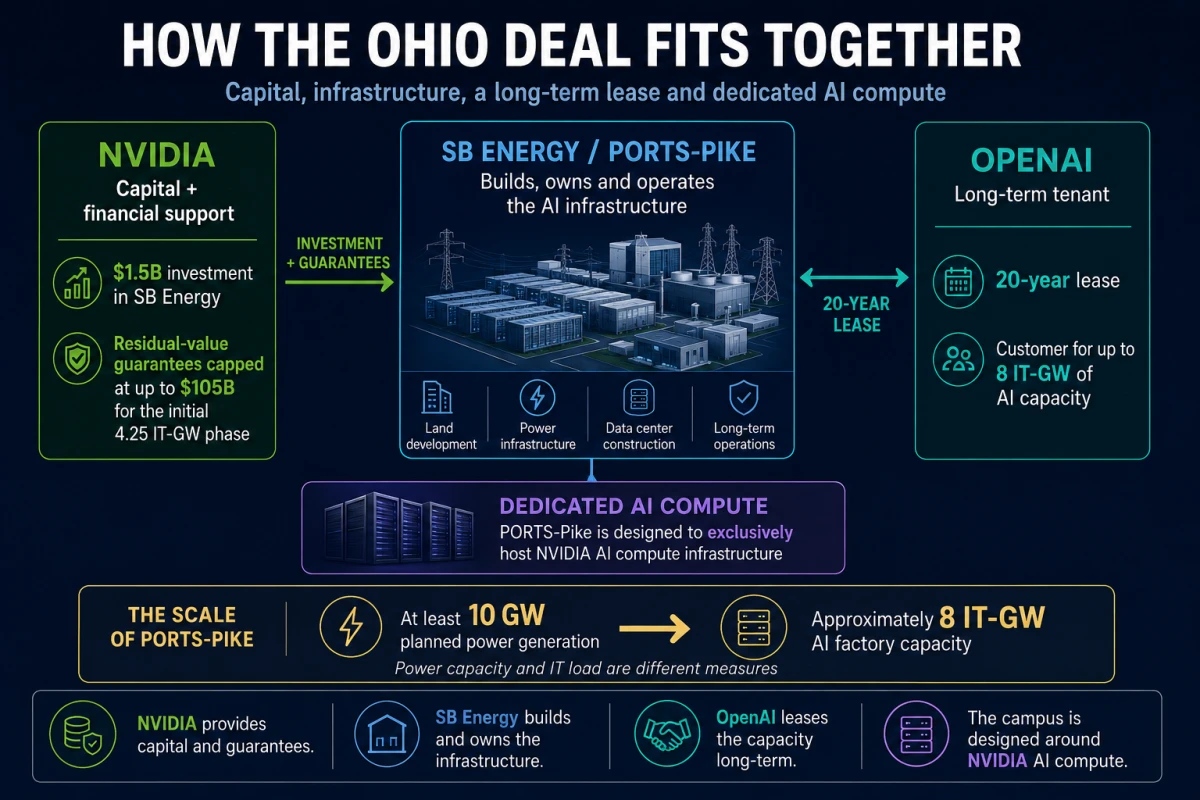
At its simplest, the transaction looks like this:
NVIDIA invests in SB Energy and provides financial support.
SB Energy builds, owns and operates the infrastructure.
OpenAI leases the capacity for 20 years.
NVIDIA’s guarantees can reduce part of the financing risk around the project.
Banks and capital markets can provide additional funding.
The data center is built around NVIDIA AI compute.
OpenAI uses that compute to run its AI systems.
NVIDIA can earn revenue as hardware and future generations of compute are deployed.
These remain separate companies, contracts and financial risks.
But taken together, they show how the AI industry is changing.
The chip supplier is no longer simply waiting at the end of the chain for a purchase order.
NVIDIA is increasingly helping build the chain itself.
Land and power are becoming as important as GPUs
There is a physical reason for this shift.
Faster GPUs are useless if customers have nowhere to install them.
Gigawatt-scale AI facilities require land, power generation, grid connections, substations, cooling, buildings, transmission capacity and enormous amounts of long-term capital.
For PORTS-Pike, SoftBank and SB Energy plan at least 10 GW of new energy generation and about $4.2 billion in new regional grid infrastructure through a partnership with AEP Ohio. NVIDIA says that power buildout is intended to support 8 IT-GW of AI factory capacity.
This is why AI infrastructure has moved far beyond the server room.
It now affects power systems, regional grids, land use and capital markets for decades.
Exclusivity makes the strategy more important
The latest NVIDIA announcement adds another important layer.
NVIDIA does not merely say that its products will be used at the site.
It describes itself as the exclusive AI compute infrastructure provider for PORTS-Pike and says the site will exclusively host NVIDIA AI factories.
Its SEC disclosure also says OpenAI will deploy NVIDIA’s full-stack DSX AI factory platform, subject to limited exceptions.
Those two statements should be read carefully rather than treated as contradictory.
The public announcement describes exclusivity at the AI compute infrastructure level, while the regulatory filing preserves limited exceptions within the contractual deployment.
But the strategic direction is clear.
NVIDIA is helping secure long-lived physical infrastructure that can continue hosting new generations of NVIDIA compute.
Huang has described the broader strategy as selectively locking up prime sites that can be upgraded repeatedly as new generations arrive.
That creates value far beyond a single GPU sale.
Once a site has land, power, transmission capacity, buildings and financing in place, replacing one generation of compute with the next becomes much easier than creating another multi-gigawatt campus from scratch.
The debt market may provide the next real test
The next important development may not come from another NVIDIA press release.
It may come from the financial markets.
Reuters reports that the financing structure has not yet been fully defined. It is expected to begin with equity — potentially including SB Energy IPO proceeds and direct SoftBank capital — followed by debt financing that could include project-finance loans and potentially public bonds.
That makes the eventual cost of borrowing extremely interesting.
If lenders are willing to finance PORTS-Pike at significantly better terms because NVIDIA stands behind part of the residual-value risk, that would provide a concrete example of NVIDIA using its balance-sheet strength to transform future AI demand into bankable physical infrastructure.
The guarantee would then have value even if NVIDIA never pays a dollar under it.
Its existence could change how lenders price the risk.
And that may ultimately be one of the most consequential parts of the entire deal.
SB Energy is also moving toward the capital markets
SB Energy may itself raise considerably more capital.
The Wall Street Journal has reported that the company is working toward a U.S. listing that could raise around $5 billion to $7 billion.
That does not mean IPO proceeds would automatically be spent on PORTS-Pike.
But it illustrates how many different capital streams are converging around AI infrastructure.
NVIDIA invests.
OpenAI becomes the long-term customer.
Banks and bond investors may finance the infrastructure.
SB Energy can raise equity.
And at the center is a physical campus designed to house NVIDIA compute.
At some point, a chip sale has become an infrastructure and capital-market ecosystem.
So who actually carries the risk?
The simple answer is: several parties do.
SB Energy builds and owns the infrastructure.
OpenAI takes on a long-term lease obligation.
Lenders and investors are expected to provide additional capital.
NVIDIA contributes both investment capital and balance-sheet support.
If everything works as planned, all of them can benefit.
OpenAI gets access to enormous compute capacity.
SB Energy gets a long-term tenant.
Investors can earn returns from infrastructure.
NVIDIA can sell generations of AI systems into the same physical campus.
The harder question appears when something fails.
If OpenAI can no longer meet its obligations, how valuable is the infrastructure to another tenant?
How quickly can it be re-leased?
At what price?
What is the residual value after several generations of AI hardware have passed?
And how much of the eventual shortfall reaches NVIDIA?
Those are exactly the questions the guarantee structure is designed to address.
There is another important layer.
According to NVIDIA’s SEC filing, OpenAI has agreed to reimburse and indemnify NVIDIA for amounts NVIDIA actually pays under the guarantees.
That gives NVIDIA a contractual claim back against OpenAI.
But if the trigger for NVIDIA’s payment were an OpenAI insolvency, the practical value of that claim would itself become a credit-risk question.
The risk moves between the parties.
It does not disappear.
Competition is becoming harder to separate from financing
There is also a competition question.
None of this means that the Ohio transaction itself violates competition law.
NVIDIA’s financial strength may help build infrastructure faster, reduce financing risk and increase the supply of AI compute.
Those are real potential benefits.
But NVIDIA already holds an unusually strong position in AI compute. The existing French competition investigation and previous concerns around CUDA dependence and NVIDIA investments in AI-focused cloud infrastructure remain relevant context. No final finding of wrongdoing has been made.
PORTS-Pike adds another dimension.
NVIDIA supplies the technology.
It invests in the infrastructure developer.
It helps support the project financially.
And the resulting campus is explicitly designed to exclusively host NVIDIA AI compute.
That does not prove anticompetitive conduct.
But it makes one future question increasingly important:
Can competing compute platforms gain access to the most valuable AI infrastructure sites if the dominant supplier increasingly helps finance and secure those sites for its own technology?
That is a question worth monitoring — not a conclusion that can be reached today.
There is also a strong case for the model
The other side of the argument matters just as much.
AI infrastructure has become so capital-intensive that even some of the world’s largest technology companies need new financing structures to build it.
NVIDIA can see demand across customers and technology generations in a way that most individual lenders cannot.
Its balance sheet can reduce perceived risk for financiers and help projects move forward that might otherwise be too expensive or difficult to fund.
If this produces more compute capacity, lower financing costs and better-utilized infrastructure, the model could create enormous value.
The real test comes later.
Will the capacity actually be used?
Will AI services generate enough economic value to support the capital invested?
Will the infrastructure retain value over multiple hardware generations?
Could another tenant use it if OpenAI disappeared?
And will alternative technology suppliers still be able to compete as chips, finance, power and physical infrastructure become increasingly intertwined?
Those questions cannot be answered by a press release.
They will be answered by utilization, cash flow, credit markets — and time.
From selling AI infrastructure to helping create the demand behind it
NextNet has previously examined NVIDIA’s attempt to build a broader financing market around AI compute.
PORTS-Pike shows what that strategy looks like when it leaves financial models and lands on a real piece of physical infrastructure.
Land.
Power generation.
Transmission lines.
Data centers.
Banks.
Twenty-year leases.
Guarantees.
And multiple future generations of AI systems.
At the center sits NVIDIA.
The company still sells chips.
But increasingly, it is also helping finance, secure and structure the infrastructure in which those chips will be deployed.
And that is why the circular-financing debate matters.
The important question is not whether the transaction fits neatly into a label.
The important question is whether NVIDIA’s expanding financial role helps create sustainable, productive AI infrastructure — or whether it makes future demand, financing and NVIDIA’s own revenue increasingly dependent on one another.
NVIDIA is no longer only selling the infrastructure of the AI boom. It is beginning to use its balance sheet to help create the conditions that make that infrastructure financeable — while securing the resulting compute demand for its own platform.
That may turn out to be one of the most important changes in the economics of AI.
💬 What do you think?
When a technology supplier also invests in, guarantees and helps secure the infrastructure where its own technology will be deployed, is that simply an efficient way to build faster — or does it create new financial and competitive risks?
Share your view in the comments.
NVIDIA’s $105 Billion Guarantees: Questions and Answers
Vad är din reaktion?
 Gilla
0
Gilla
0
 Ogilla
0
Ogilla
0
 Kärlek
0
Kärlek
0
 Rolig
0
Rolig
0
 Wow
0
Wow
0
 Ledsen
0
Ledsen
0
 Arg
0
Arg
0

Hej, jag heter Staffan Carlsson
Jag är grundare och ansvarig utgivare för NextNet.se – en svensk nyhetsplattform med fokus på artificiell intelligens, teknik, cybersäkerhet och digital innovation.
Varför NextNet?
Jag startade NextNet med målet att skapa en modern och lättillgänglig nyhetssajt där teknik och AI står i centrum. Den tekniska utvecklingen går snabbare än någonsin, och jag tror att det är viktigare än någonsin att kunna förstå vad som händer – utan att behöva vara expert.
Genom NextNet vill jag lyfta fram nyheter, analyser och trender som hjälper läsare att navigera i en allt mer digital värld.
Mitt teknikintresse
Teknik har varit en stor del av mitt liv under många år. Jag fascineras av hur innovation, internet och artificiell intelligens förändrar sättet vi arbetar, kommunicerar och bygger framtidens samhälle.
Utöver arbetet med NextNet ägnar jag mycket tid åt webbplattformar, servermiljöer, AI-lösningar och digitala projekt där nyfikenhet och lärande alltid står i centrum.
Min vision
Jag vill att NextNet ska vara en trovärdig och inspirerande källa för alla som vill följa utvecklingen inom AI, teknik och digitalisering – oavsett tidigare kunskapsnivå.
AI-drivna nyheter för en digital värld.













Kommentarer (0)