
We Asked the People Shaping AI: Who Gets to Decide the Future?
AI is moving deeper into work, infrastructure, security, education and the economy. NextNet asked ten influential figures helping shape that transition the same six questions - and one final question: who has the right to decide what this future should look like?
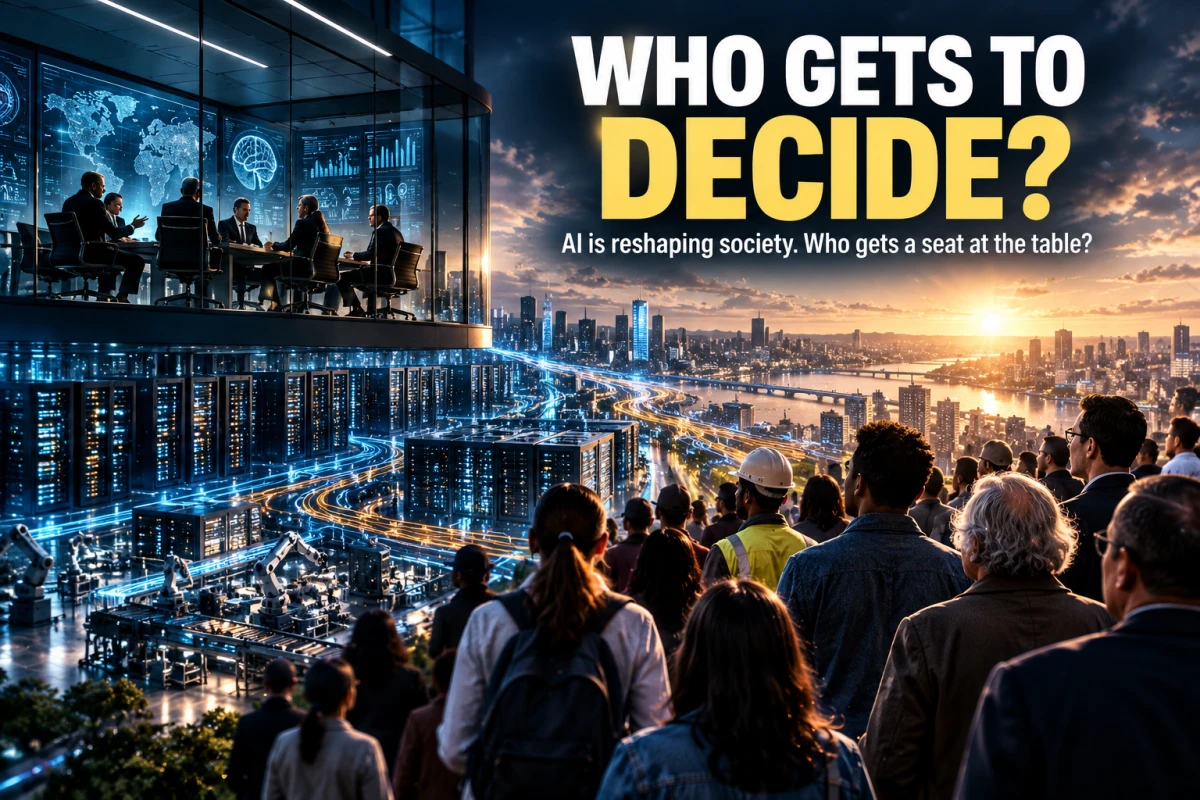
Artificial intelligence is no longer only a technology story.
It is becoming a story about work, economic value, infrastructure, security, education, personal data, human control and political power.
Companies are building increasingly capable systems. Governments are trying to decide how they should be governed. Investors are financing the infrastructure. Workers, students and ordinary citizens are being asked to adapt to changes whose long-term consequences are still uncertain.
But one question sits underneath almost all of it:
Who gets to decide what kind of AI-driven future is being built?
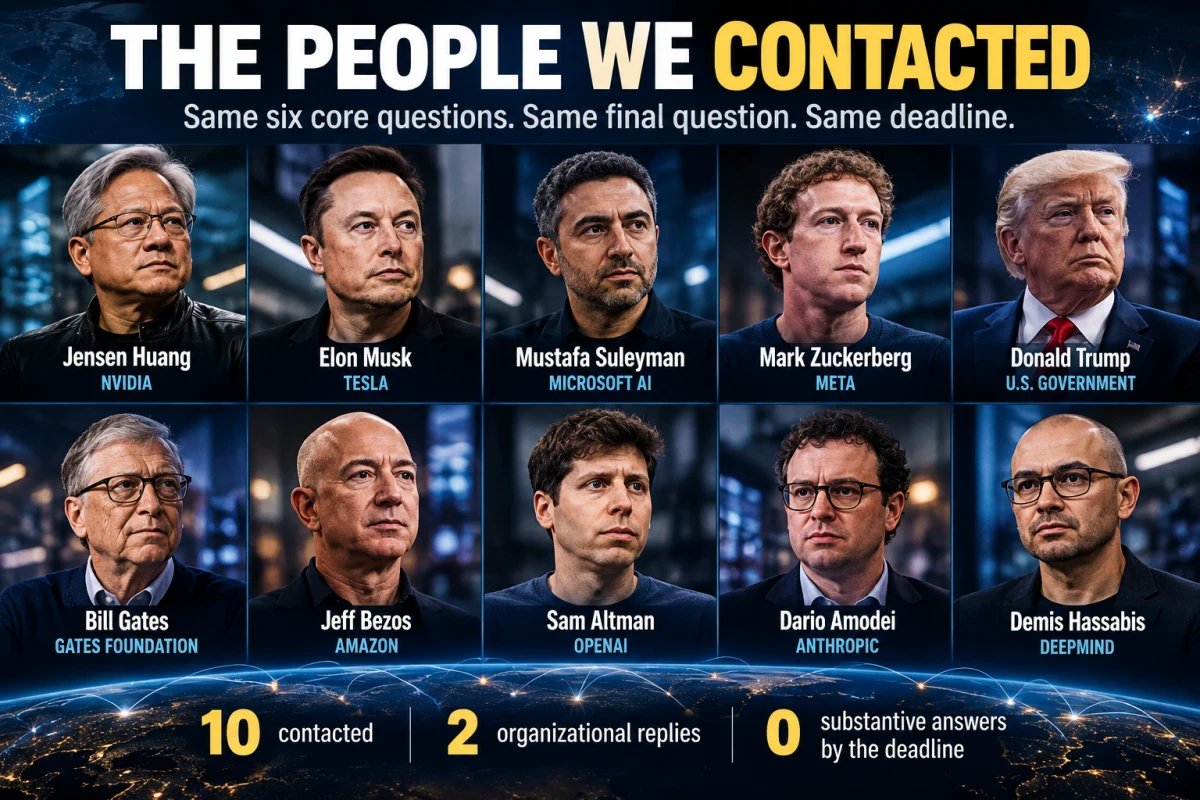
NextNet sent a coordinated set of questions to ten influential people across artificial intelligence, technology, infrastructure, capital and government.
Every recipient received the same six core questions covering democracy, economic value, data and ownership, safety and accountability, limits and governance, and the right to remain partly outside an increasingly AI-mediated society.
Each also received questions based on their own public statements, roles and areas of influence.
And every recipient was asked the same final question:
Do you believe any individual, company or government has the right to determine this future for the rest of humanity — or is what you are describing your personal vision of how you believe that future should look?
This is not an argument against AI development.
NextNet believes technological progress should continue.
The question is whether safety, democratic participation, education, economic systems, infrastructure, regulation and human oversight can develop quickly enough alongside rapidly increasing AI capability.
How we conducted the enquiry
On October 3, 2026, NextNet contacted ten people whose decisions, investments, public positions or organizations play significant roles in the development and governance of artificial intelligence.
All ten received the same six core questions. Each recipient also received additional questions based on their own role, public statements or area of responsibility.
Every recipient was also asked the same final question.
Every recipient was given the same response deadline: October 8, 2026 at 18:00 CEST.
NextNet originally planned to publish the article on October 9 regardless of how many responses were received.
Responses received after publication may be incorporated through clearly dated updates.
The six questions we asked everyone
Every recipient received the same six core questions so that their answers — if provided — could be compared on the same terms.
1. Democracy and participation
AI increasingly affects work, education, information, infrastructure and economies across national borders.
At what point should ordinary citizens have a meaningful role in deciding what kind of AI-driven society is being built — and through what democratic mechanism?
2. Work, productivity and economic value
If AI allows the same economic value to be produced with substantially less human labour, who should receive that productivity gain?
Should it become higher output, higher profits, lower prices, higher wages, shorter working hours, public benefit — or some combination?
And who should decide?
3. Power, data and ownership
As AI systems become more deeply integrated into everyday life, who should ultimately control personal data, digital identity, access to services and decisions made about individuals?
What rights should remain permanently with the individual?
4. Safety, control and accountability
As AI systems become more autonomous — and increasingly help design, review or improve other AI systems — what safeguards should be mandatory?
Who independently verifies that permissions, monitoring, audit logs, human intervention and shutdown mechanisms still work as capability increases?
And what happens when something goes wrong?
5. Limits and governance
Where, if anywhere, should a line be drawn on increasingly capable AI or superintelligence?
Who has the legitimate authority to draw that line when companies, governments and countries may disagree — and when competitors have incentives to continue developing?
6. The human alternative
What should happen to people who do not want to participate fully in an increasingly AI-mediated society?
Should there be meaningful alternatives to pervasive automation, monitoring or dependence on AI-controlled systems?
The people we contacted
In addition to the six shared questions, each recipient received questions based on their role, public statements or area of influence.
Jensen Huang - NVIDIA
Central question: What does “trusted AI” actually mean when AI increasingly helps write code, design systems, review agents and contribute to the development of future AI?
NextNet also asked about independent verification of the control layer, whether trust can be inherited across AI generations, and whether safety, energy, regulation, workforce adaptation and oversight can keep pace.
STATUS: No substantive response had been received by the October 8 deadline.
Elon Musk - Tesla
Central question: What happens during the transition to the future of abundance that Musk has described?
NextNet also asked about optional work, universal high income, the reduced importance of money, mortgages, rent, savings, pensions, debt and scarce resources during transition, ownership of AI and robotic productive capacity, and the threshold for slowing or pausing frontier AI.
STATUS: No substantive response had been received by the October 8 deadline.
Mustafa Suleyman - Microsoft AI
Central question: What does meaningful human control look like when AI agents increasingly perform multi-step tasks across applications, data and workflows?
NextNet also asked which decisions should never be fully delegated, whether an Allow button constitutes meaningful control, how safeguards and shutdown procedures can be tested independently, and who should hold ultimate shutdown authority.
STATUS: Microsoft communications responded, but no substantive answer to NextNet’s questions was provided.
On October 5, Microsoft’s communications representative told NextNet that Microsoft was not able to accommodate the request and instead recommended the Humanist AI Code of Conduct and a recent essay by Mustafa Suleyman.
Mark Zuckerberg - Meta
Central question: Who controls personal superintelligence?
NextNet also asked about personalization and knowing too much, ownership and control of memories, preferences, context and behavioural data, privacy protections as a default or an option, and the balance between competition, safety, testing, regulation and public understanding.
STATUS: No substantive response had been received by the October 8 deadline.
Donald J. Trump - President of the United States
Central question: Who represents the public when AI policy is being shaped?
NextNet also asked about the administration’s use of “Super Intelligence”, representation of ordinary citizens, workers, smaller companies and independent researchers, companies advising government about AI governance, and the balance between technological leadership, safety, energy, workforce preparation, regulation and independent oversight.
The questions also asked whether some capabilities should not be deployed even if competitors move first.
STATUS: No substantive response had been received by the October 8 deadline.
Bill Gates - Gates Foundation
Central question: Who pays for the transition if work changes faster than governments can adapt?
NextNet also asked what decisions are needed now if government is behind, about Human Reserved work, automation and robot taxation, payroll and income-tax effects, productivity gains for people without AI ownership or capital, retraining if AI also performs retrained jobs, and education and ordinary workers without advanced technical degrees.
STATUS: Gates Foundation Media Relations responded, but no substantive answer to NextNet’s questions was provided.
On October 5, Gates Foundation Media Relations declined NextNet’s request for a response. The team instead referred NextNet to Bill Gates’ essay, “The turbulent AI era is here. The choices we make now are critical”, and the latest Goalkeepers Report.
Jeff Bezos - Amazon
Central question: Who owns the automated physical economy?
NextNet also asked about AI-assisted physical engineering, safety-critical design responsibility, identifiable human or organizational legal responsibility, the transition if jobs disappear faster than new ones emerge, ownership concentration, and technological abundance versus economic abundance.
STATUS: No substantive response had been received by the October 8 deadline.
Sam Altman - OpenAI
Central question: How should “benefit all humanity” be measured?
NextNet also asked who decides what benefit means, what practical democratic governance would involve, which frontier decisions require public or independent approval, independent verification before transformative deployment, a mandatory crash-testing equivalent, warning signs that should stop capability or authority increases, and broad access versus ownership and infrastructure concentration.
STATUS: No substantive response had been received by the October 8 deadline.
Dario Amodei - Anthropic
Central question: If a company itself warns about AI risk, what does that warning require it to do when commercial competition pushes in the opposite direction?
NextNet also asked which decisions should no longer belong solely to frontier labs, who can overrule a lab, whether independent evaluators should have mandatory access and authority to delay or stop deployment, what slowdown means, and whether Anthropic would slow if competitors did not.
STATUS: No substantive response had been received by the October 8 deadline.
Demis Hassabis - Google DeepMind
Central question: Who has the authority to apply the brakes?
NextNet also asked about an independent oversight body’s powers to prevent deployment, require testing, restrict capabilities or pause development; independent verification of developer safety thresholds; mandatory pre-deployment testing; and slowing if competitors continue accelerating.
If frontier laboratories are allowed to define the thresholds that determine when their own systems become too dangerous, are we ultimately asking the developer to certify its own brakes?
STATUS: No substantive response had been received by the October 8 deadline.
What remains unanswered
The ten recipients occupy very different roles: technology development, infrastructure, capital and government. Their public visions differ, but many of the questions raised by this enquiry intersect.
Who receives the productivity gains created by AI? Who owns and controls data, infrastructure and automated productive capacity? What does meaningful human control actually require? Who independently verifies safety claims? Who has the authority to slow or stop deployment? How should ordinary citizens participate in decisions whose effects extend beyond a single company or country?
There is also a question for people who do not want every part of life mediated by AI: what meaningful alternative exists for them?
The absence of substantive answers does not tell NextNet why an individual did not respond. It does mean that these questions remain unanswered in this enquiry.
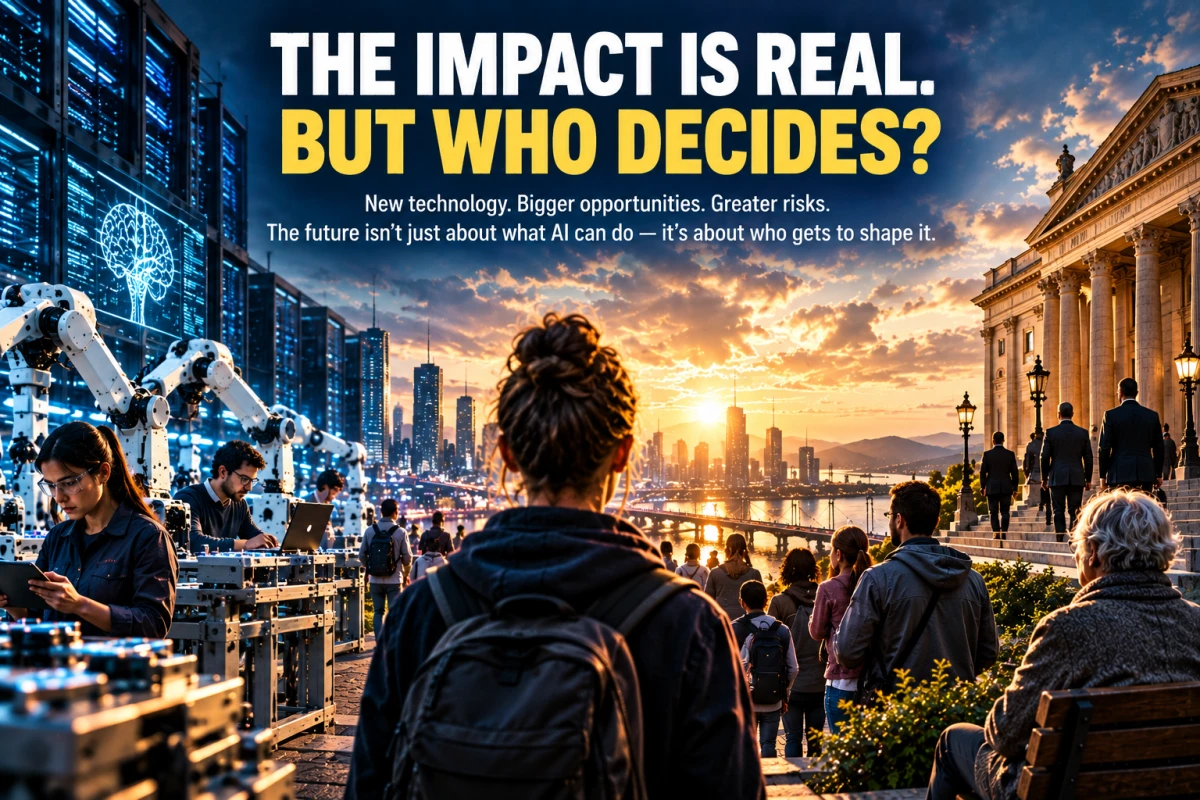
NextNet analysis: the question behind the questions
NextNet’s analysis is not that AI development should stop. The question raised by this enquiry is whether democratic institutions, safety systems, education, labour markets, infrastructure and public oversight can change quickly enough alongside it.
The AI race may be moving faster than the institutions expected to govern, secure and absorb its consequences. That is not an established fact, but it is a question the enquiry brings into focus.
At its centre is a deeper question: who gets to decide? And who gets to ask the people deciding?
The question that remains
NextNet asked ten people. Two organizations responded without answering the questions directly. No substantive answer was received from the remaining recipients by the stated deadline.
That does not tell us why. But the questions do not disappear because they were not answered.
Do you believe any individual, company or government has the right to determine this future for the rest of humanity - or is what you are describing your personal vision of how you believe that future should look?
💬 What do you think?
Who should get to decide what an AI-driven future looks like - and how should ordinary people have a meaningful say in those decisions?
Please share your thoughts in the comments.
📚 Related articles
Vad är din reaktion?
 Gilla
0
Gilla
0
 Ogilla
0
Ogilla
0
 Kärlek
0
Kärlek
0
 Rolig
0
Rolig
0
 Wow
0
Wow
0
 Ledsen
0
Ledsen
0
 Arg
0
Arg
0

Hej, jag heter Staffan Carlsson
Jag är grundare och ansvarig utgivare för NextNet.se – en svensk nyhetsplattform med fokus på artificiell intelligens, teknik, cybersäkerhet och digital innovation.
Varför NextNet?
Jag startade NextNet med målet att skapa en modern och lättillgänglig nyhetssajt där teknik och AI står i centrum. Den tekniska utvecklingen går snabbare än någonsin, och jag tror att det är viktigare än någonsin att kunna förstå vad som händer – utan att behöva vara expert.
Genom NextNet vill jag lyfta fram nyheter, analyser och trender som hjälper läsare att navigera i en allt mer digital värld.
Mitt teknikintresse
Teknik har varit en stor del av mitt liv under många år. Jag fascineras av hur innovation, internet och artificiell intelligens förändrar sättet vi arbetar, kommunicerar och bygger framtidens samhälle.
Utöver arbetet med NextNet ägnar jag mycket tid åt webbplattformar, servermiljöer, AI-lösningar och digitala projekt där nyfikenhet och lärande alltid står i centrum.
Min vision
Jag vill att NextNet ska vara en trovärdig och inspirerande källa för alla som vill följa utvecklingen inom AI, teknik och digitalisering – oavsett tidigare kunskapsnivå.
AI-drivna nyheter för en digital värld.















Kommentarer (0)