
The AI Race Is Starting to Look Like One Interconnected System
The AI race is becoming an interconnected industrial system. NVIDIA’s record growth, OpenAI’s custom silicon, SpaceXAI’s orbital ambitions and new financing models show how chips, infrastructure, capital, energy, regulation and human work are increasingly tied together.

At first glance, the past few days have produced a collection of separate AI stories.
NVIDIA reported another record quarter. Amazon Web Services announced plans for millions more NVIDIA GPUs. OpenAI published the first measured results from its own inference chip. SpaceXAI deepened its use of NVIDIA Vera Rubin while continuing to describe its future orbital architecture as vendor-agnostic. Louisiana announced a $100 billion SpaceX campus that is intended to support launch activity on a scale that also reaches orbital data centers.
Read separately, these are stories about chips, rockets, data centers and investment.
Read together, they are beginning to look like something else.
The AI race is starting to become one interconnected industrial system.
NVIDIA's results make one simple explanation harder to sustain
NVIDIA's latest financial results are important because they make one tempting interpretation of what is happening harder to sustain.
Demand has not disappeared.
NVIDIA reported second-quarter fiscal 2027 revenue of $96.2 billion, up 106 percent from a year earlier. Data Center revenue reached $89.0 billion, up 117 percent. The company expects approximately $108 billion in revenue for the third quarter.
Those are not the numbers of a company currently facing a collapse in AI demand.
But another part of the report matters just as much.
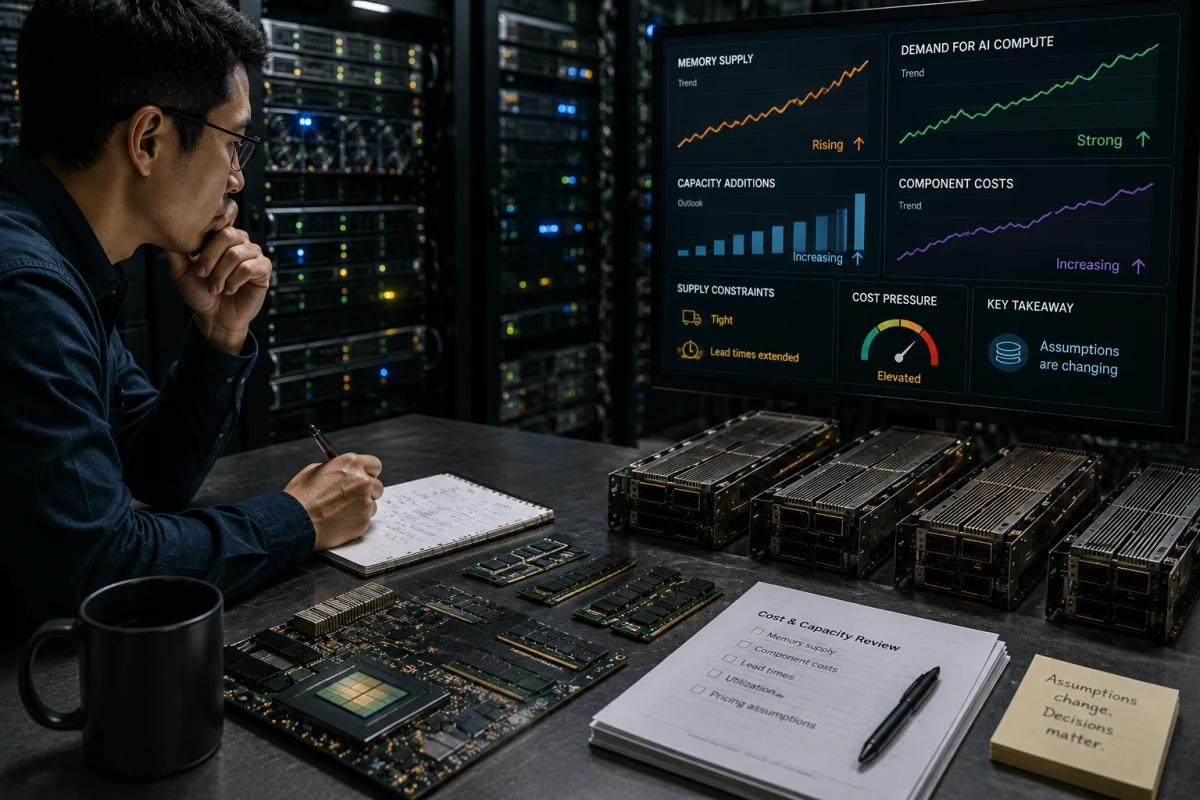
NVIDIA said memory pricing has increased more than it previously expected. Gross margin was 75 percent in the second quarter and is expected to fall to approximately 74 percent in the third. Management expects margins to bottom in the 71–72 percent range in the fourth quarter before settling around 72–73 percent in fiscal 2028 as product price increases begin taking effect.
The important point is not that NVIDIA's business is suddenly weak.
It is that extraordinary demand can coexist with changing costs, margins and pricing assumptions.
The same AI buildout that creates demand for NVIDIA systems is also placing pressure on memory supply and other parts of the supply chain.
That is what an interconnected system looks like.
NVIDIA is no longer only supplying the accelerator
It is increasingly difficult to describe NVIDIA as simply the company selling the GPU inside the AI data center.
The company now spans accelerators, CPUs, networking, rack-scale systems, software, inference infrastructure and design frameworks for complete AI factories.
It has also moved further into the financing layer.
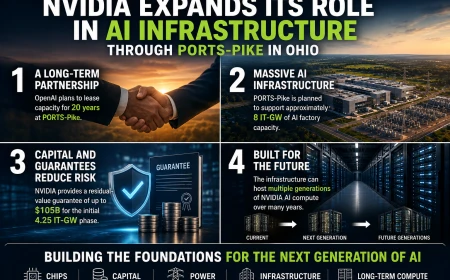
NVIDIA has announced partnerships with Apollo, BlackRock, Blackstone, Brookfield, Goldman Sachs and KKR intended to mobilize more than $500 billion of third-party capital for AI infrastructure over time, subject to definitive agreements.
NVIDIA describes compute itself as an investable infrastructure asset.
That changes the economic picture.
A chip sale can now sit inside a much longer chain:
capital finances infrastructure, infrastructure purchases compute, compute is rented or used to generate AI services, and the resulting revenue is expected to support returns to the investors who financed the system.
The more layers that become connected, the more important assumptions about demand, utilization, useful life and future value become.
SpaceXAI shows how far the stack can extend
SpaceXAI provides one of the clearest examples of how broad this infrastructure stack is becoming.
NVIDIA says SpaceXAI will deploy Vera CPUs for agentic workloads and expand Grok infrastructure around the Vera Rubin platform. NVIDIA also says the first generation of SpaceXAI's Starmind AI satellite is planned around an optimized Vera Rubin NVL72 system.
That moves NVIDIA infrastructure beyond terrestrial data centers and toward orbital compute.
At the same time, SpaceX's planned Louisiana expansion adds another physical layer.
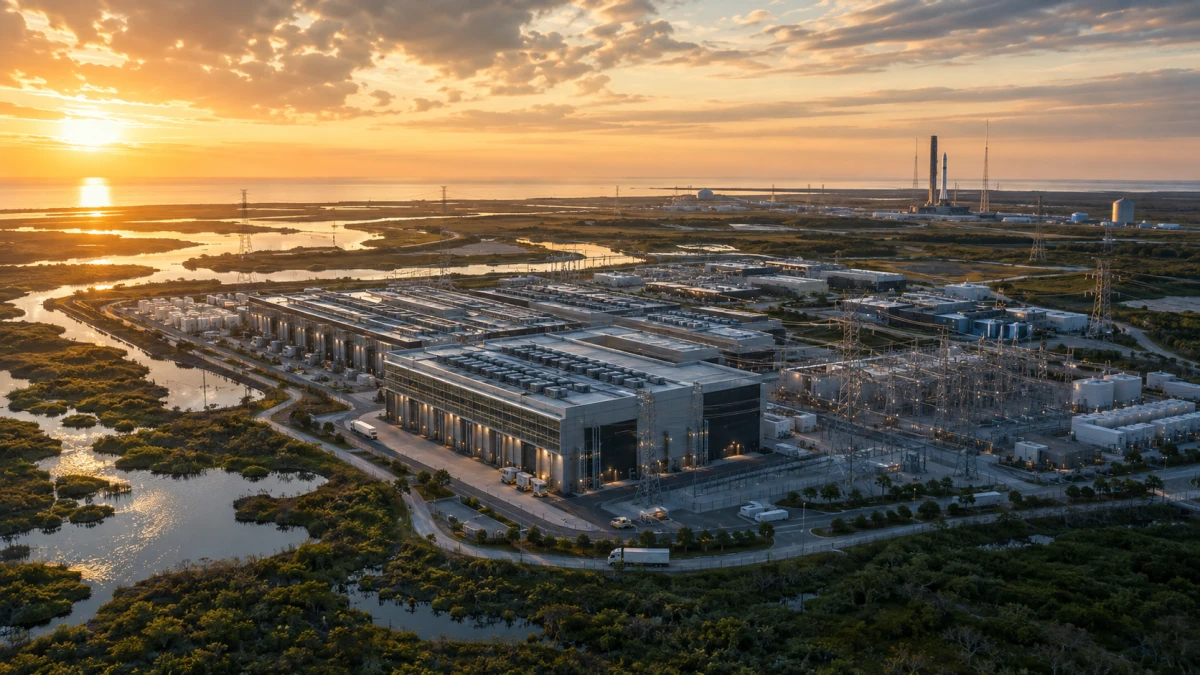
Louisiana says SpaceX intends to invest $100 billion in a roughly 125,000-acre campus in Vermilion Parish. At full buildout, the site is expected to include five launch complexes with two pads each, along with propellant production, power generation, vehicle processing and employee housing.
The state explicitly lists orbital data centers among the missions the site could support.
That does not make Starbase Louisiana a dedicated Starmind facility. Its stated purposes are much broader and include Earth orbit, connectivity, the Moon and Mars.
But it illustrates a basic physical constraint on orbital AI.
Compute cannot reach orbit through software alone.
It requires rockets, launch pads, propellant, power, transport infrastructure and a launch cadence capable of placing very large amounts of hardware into space.
The AI stack is beginning to reach all the way from silicon manufacturing to launch infrastructure.
The customers are building alternatives at the same time
This growing integration does not mean the largest AI companies want to depend permanently on one technology supplier.
OpenAI has now published the first measured results from Jalapeño, its first custom inference chip.
In OpenAI's own tests across several public models, Jalapeño delivered between 1.5 and 1.9 times more AI work per watt at peak throughput and between 1.7 and 3.6 times lower end-to-end latency than the comparison systems.
Those are OpenAI's measurements and comparisons, not an independent industry-wide finding.
But they matter because Jalapeño is no longer only a future chip roadmap. OpenAI describes it as working first-party silicon, plans deployment inside its own infrastructure by the end of the year and says additional generations are already in development.
OpenAI also says something equally important:
This is not necessarily an exit from NVIDIA.
It is optionality.
SpaceX is pursuing a similar principle from another direction. The first generation of Starmind may use NVIDIA technology, while SpaceX continues to describe the broader architecture as AI-chip vendor-agnostic.
The largest AI builders therefore appear to be pursuing two goals at the same time:
secure as much high-performance compute as possible today, while preserving more choices for tomorrow.
NVIDIA is building for a world with custom silicon
NVIDIA has clearly not ignored this development.
Its own regulatory filings already warn that some major customers are developing their own ASICs and other products, and that stronger competition can result in lower-than-expected selling prices or demand.
But NVIDIA's strategic answer is not simply to try to prevent customers from designing chips.
That changes the competitive question.
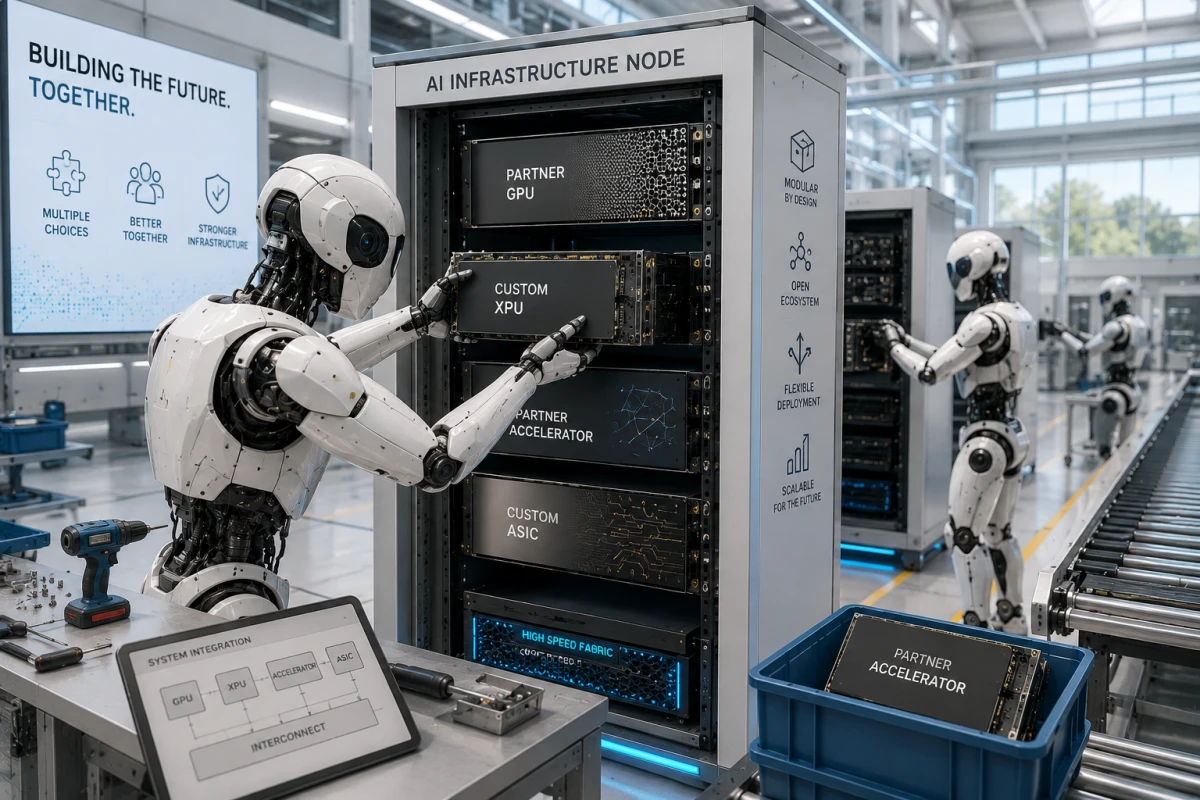
A customer may eventually replace an NVIDIA accelerator for a particular workload without necessarily replacing NVIDIA networking, rack architecture, software, infrastructure tooling or other parts of the platform around it.
Custom silicon does not necessarily mean leaving NVIDIA.
NVIDIA is increasingly designing its infrastructure so that customers can replace parts of the compute layer without replacing the entire platform around it.
If that strategy succeeds, NVIDIA does not need to win every accelerator decision in order to remain economically important to the AI factory.
An alternative does not have to win to change the economics
That does not make competition irrelevant.
The economic effect can begin long before a competing chip captures a dominant share of the market.
A credible alternative changes a negotiation.
If a large customer can realistically move part of a future workload to its own accelerator, another supplier or another architecture, the customer has more options when price, capacity and contract terms are discussed.
For investors, the same development can change assumptions about future pricing power, utilization and asset value.
An alternative does not have to replace NVIDIA to matter. It only has to become credible enough to change expectations about pricing power, margins and future value.
That does not mean NVIDIA's profits must decline.
Lower compute prices can expand the market. More efficient inference can create new workloads. NVIDIA can lose some economics at one layer while gaining revenue from networking, CPUs, software or infrastructure elsewhere in the system.
The net result cannot be known in advance.
That uncertainty is exactly why long-term investment assumptions matter.
The capital layer is becoming part of the technology stack
AI infrastructure increasingly requires more than technological confidence.
It requires enormous amounts of long-duration capital.
NVIDIA's financing partnerships are designed to connect institutional investors with AI infrastructure that uses NVIDIA compute. Other projects involve guarantees, leases, project finance, equity and long-term infrastructure commitments.
That can accelerate deployment dramatically.
It can also make the assumptions behind the financing more important.
If a project is financed on expectations about compute demand, utilization, pricing and long-term equipment value, changes in any of those assumptions can affect the expected return even when the technology itself works exactly as designed.
This is the distinction NextNet has followed in its recent AI infrastructure stress test:
technical success is not the same thing as financial success.
But the opposite also matters.
A more diversified technology market does not automatically make infrastructure financing weaker. If custom silicon can operate inside common infrastructure and lower the cost of useful AI output, a more flexible platform could make financed assets more useful rather than less.
The system eventually reaches land, power, nature and communities
The Louisiana project also shows why AI infrastructure cannot be analyzed only from inside a server rack.
For roads and bridges, however, the state says the scope and responsibility for improvements are still being determined and that some cost sharing between Louisiana and SpaceX is expected.
The economic package includes an upfront local payment, annual payments over 25 years and a charitable contribution to the Community Foundation of Acadiana.
The state also describes work with the Coastal Protection and Restoration Authority on hydrology, habitat restoration, shoreline stabilization and long-term management of the property.
But in the public project material reviewed by NextNet, there is not yet a separately quantified dollar amount identifying how much of the $100 billion investment is specifically reserved for environmental or habitat restoration.
That does not mean no such budget exists.
It means the amount is not publicly specified in the material reviewed.
The groups point to the sensitivity of the Pecan Island coastal wetlands, wildlife habitat, erosion and hurricane exposure.
Those concerns are not proof that the SpaceX project will cause the outcomes the groups fear.
But they are part of the infrastructure equation.
Permitting, restoration, transport, power, insurance, local acceptance and environmental obligations can affect timelines, costs and ultimately financing.
Nature and communities are not outside the economic model simply because they do not appear on a chip specification sheet.
The system also reaches the labor market
The economic value behind the AI infrastructure boom ultimately depends on what the resulting compute can do.
That means the system does not stop at chips, data centers, power plants or launch pads.
It eventually reaches work itself.
Gates expects the disruption to spread across areas including law, customer service, medicine, software and manufacturing over roughly a decade rather than several generations. He argues that many jobs could disappear permanently and that retraining alone may not be sufficient.
These are Gates's expectations, not an established forecast of how employment will develop.
But his proposed response illustrates another layer of uncertainty around the AI infrastructure boom.
Gates has introduced the idea of “Human Reserved” work — occupations or tasks that societies could deliberately preserve for people even where AI or robotics becomes technically capable of performing them.
He has also renewed his longstanding argument that governments may need to change how automation is taxed, including taxes related to AI usage and robotics.
Those proposals may never become policy in their current form.
But they expose an important economic question.
If governments eventually change taxes, labor rules or deployment restrictions in response to large-scale automation, the economics of using AI infrastructure could change even when the infrastructure itself performs exactly as intended.
The same interconnected system therefore has another endpoint:
the people whose work, incomes and communities the technology is expected to transform.
The enormous investment in compute is based on expectations of enormous productivity.
How those productivity gains are distributed — and how governments respond if the gains also produce widespread displacement — may eventually become part of the investment calculation itself.

Interconnection can create resilience — and transmit pressure
There is a powerful positive case for this increasingly connected system.
Standardized infrastructure can make custom silicon easier to deploy. Large financing pools can make compute accessible to companies that could not build gigawatt-scale infrastructure from their own balance sheets. Better chips can reduce cost per token. More efficient inference can expand demand. Shared platforms can allow expensive infrastructure to support more types of workloads.
AWS provides a useful example.
Those strategies can coexist.
In fact, that may increasingly be the model.
The customer preserves choice at the silicon layer while relying on a mixture of internal technology and external infrastructure platforms.
But interconnection also allows pressure to travel.
Stronger AI demand can tighten memory supply.
Tighter memory supply can increase hardware costs.
Higher hardware costs can influence margins or customer pricing.
More expensive infrastructure can require more capital.
More capital can make financing terms and expected returns more important.
Physical expansion requires land, power, transport and regulatory approval.
Automation can eventually affect employment, taxation and political responses.
Changes at those layers can alter how quickly AI is deployed and how its economic returns are distributed.
No single part has to fail for another part of the calculation to change.
The question is becoming larger than who builds the fastest chip
The next phase of the AI race may therefore be harder to measure with a simple market-share chart.
NVIDIA's position in accelerators still matters enormously.
But so does its position in networking, CPUs, software, rack architecture and financing.
OpenAI's own chip matters.
But so does OpenAI's continued use of NVIDIA systems.
SpaceXAI's first Starmind architecture matters.
But so do Starship launch capacity, Louisiana infrastructure, energy, manufacturing and the economics of placing compute in orbit.
Investors matter.
So do the people, communities and physical environments in which the infrastructure is actually built.
And if AI begins replacing significant amounts of human cognitive work, employment, taxation and public policy become part of the same system as well.
That is why the most useful question may no longer be:
Who wins the AI chip race?
It may become:
Which parts of the system remain indispensable when customers gain more choices — and who carries the risk when one of the assumptions changes?
NVIDIA's latest results show that the AI buildout is still accelerating.
The emergence of custom silicon shows that customers are simultaneously preparing for a future with more alternatives.
NVIDIA's response shows that the company is trying to make those alternatives compatible with the infrastructure it provides.
SpaceX shows how the physical infrastructure can extend from the data center to the launch pad and potentially into orbit.
And Gates's intervention shows why the consequences ultimately return to the economy and the people inside it.
The enormous projects now appearing around AI therefore cannot be understood only as technology investments.
The AI race is not becoming simpler as it grows.
It is becoming a system.
💬 What do you think?
As AI companies build more of their own technology while continuing to depend on shared infrastructure, where do you think the most durable power — and the greatest long-term risk - will sit: silicon, platforms, capital, energy, physical infrastructure or the wider economy?
Share your view in the comments.
📚 Related articles
Frequently Asked Questions About the Interconnected AI Race
Vad är din reaktion?
 Gilla
0
Gilla
0
 Ogilla
0
Ogilla
0
 Kärlek
0
Kärlek
0
 Rolig
0
Rolig
0
 Wow
0
Wow
0
 Ledsen
0
Ledsen
0
 Arg
0
Arg
0

Hej, jag heter Staffan Carlsson
Jag är grundare och ansvarig utgivare för NextNet.se – en svensk nyhetsplattform med fokus på artificiell intelligens, teknik, cybersäkerhet och digital innovation.
Varför NextNet?
Jag startade NextNet med målet att skapa en modern och lättillgänglig nyhetssajt där teknik och AI står i centrum. Den tekniska utvecklingen går snabbare än någonsin, och jag tror att det är viktigare än någonsin att kunna förstå vad som händer – utan att behöva vara expert.
Genom NextNet vill jag lyfta fram nyheter, analyser och trender som hjälper läsare att navigera i en allt mer digital värld.
Mitt teknikintresse
Teknik har varit en stor del av mitt liv under många år. Jag fascineras av hur innovation, internet och artificiell intelligens förändrar sättet vi arbetar, kommunicerar och bygger framtidens samhälle.
Utöver arbetet med NextNet ägnar jag mycket tid åt webbplattformar, servermiljöer, AI-lösningar och digitala projekt där nyfikenhet och lärande alltid står i centrum.
Min vision
Jag vill att NextNet ska vara en trovärdig och inspirerande källa för alla som vill följa utvecklingen inom AI, teknik och digitalisering – oavsett tidigare kunskapsnivå.
AI-drivna nyheter för en digital värld.













Kommentarer (0)