
The AI Stress Test May Be Starting Earlier Than Expected
The AI infrastructure boom is still attracting extraordinary amounts of capital and customer demand. But some of the assumptions behind today’s largest projects are already beginning to move. Reported server-price increases, rising memory costs, more selective credit markets and regulatory uncertainty are arriving before much of the next generation of AI infrastructure is even operational. The question is not whether the boom is collapsing. It is what happens when hardware, capital and expected returns begin to be repriced at the same time.
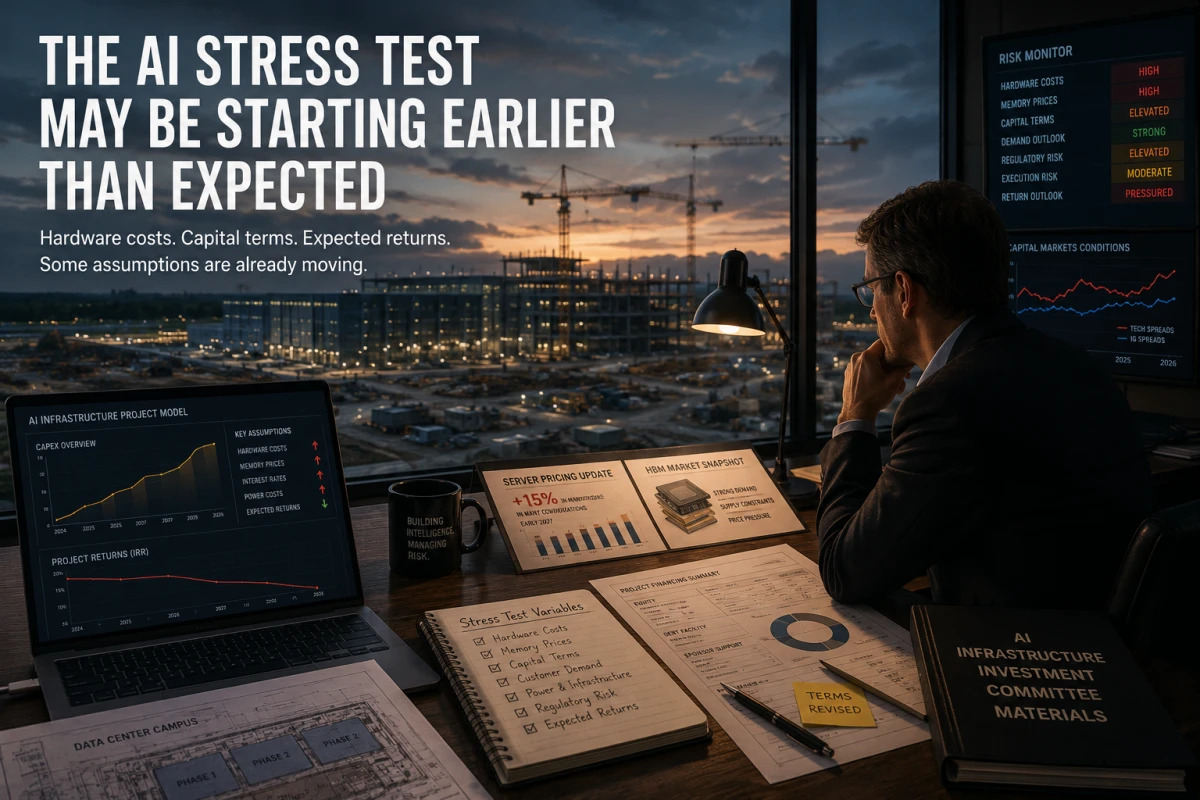
The largest AI infrastructure projects are being built around assumptions about a future that has not arrived yet.
Hardware prices.
Customer demand.
Interest rates.
Power costs.
Compute pricing.
Technology cycles.
Residual values.
And the willingness of investors to keep supplying enormous amounts of capital.
In Stress-Testing the AI Race, NextNet asked what could happen if some of those assumptions changed before today’s multi-gigawatt infrastructure projects reached full operation.
The stress test was supposed to come later.
Some of the variables may already be moving.
The first variable to move may be hardware cost
Bloomberg reported on August 22 that some of NVIDIA’s largest customers had been told that prices for servers containing its AI chips would rise by more than 15 percent in many configurations for systems shipped from early 2027.
The reported increases include systems based on Vera Rubin and Grace Blackwell and are said to vary according to hardware generation and memory configuration.
Reuters relayed the report but said it could not independently verify the information. NVIDIA had not publicly commented on the reported increases at the time of writing.
That distinction matters.
A reported price increase is not the same thing as a universal 15-percent increase across every NVIDIA system, every customer and every contract.
Existing agreements may contain different pricing arrangements. Future orders may be negotiated differently. Some customers may have secured components or commercial terms earlier than others.
But the report introduces an important new variable.
Infrastructure that will not be operational for several years can become more expensive before it has even been built.
Memory is becoming infrastructure economics
The reported reason for much of the increase is not simply the GPU.
It is memory.
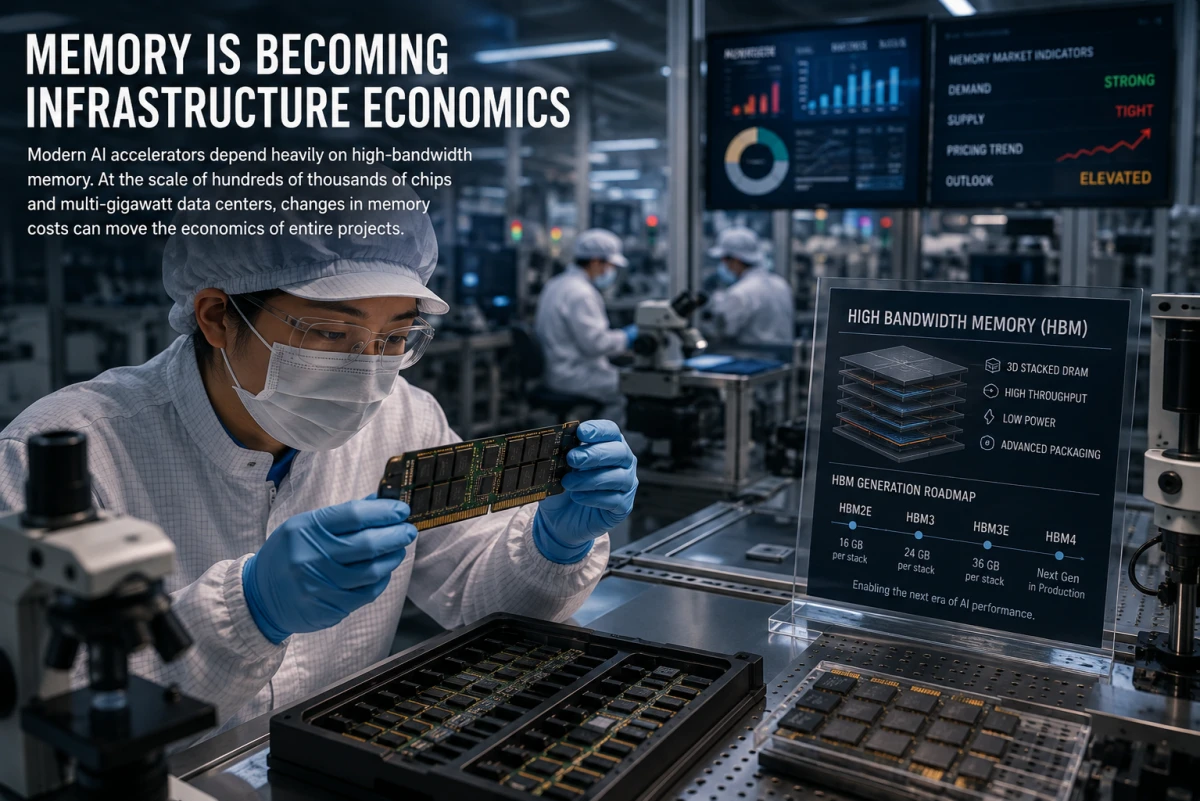
Modern AI accelerators depend heavily on high-bandwidth memory, and the next generation is extraordinarily memory-intensive.
NVIDIA’s Vera Rubin NVL72 specifications show just how large these rack-scale systems have become.
That makes memory pricing much more than a component-level detail.
At the scale of hundreds of thousands of accelerators and multi-gigawatt data centers, changes in HBM costs can move the economics of an entire infrastructure project.
Memory suppliers are simultaneously describing very strong demand.
SK hynix has reported strong AI-memory demand and continued expansion of HBM4 production.
Micron has also announced high-volume production of HBM4 designed for NVIDIA Vera Rubin.
That is not evidence of an AI slowdown.
If anything, it points to the opposite problem:
Demand for the components needed to build AI infrastructure may be strong enough to make the infrastructure itself more expensive.
Customers have not walked away
There is an important counterpoint.
So far, there is no documented public revolt among major customers over the reported increases.
The Reuters report says server manufacturers supplying major data-center operators have been communicating the forthcoming pricing changes to customers.
But public reporting reviewed by NextNet has not yet produced a named hyperscaler saying that it is reducing or cancelling NVIDIA orders specifically because of those increases.
That matters because higher prices can mean very different things depending on the strength of demand.
If customers still believe the compute will generate enough value, they may accept higher prices.
Cloud providers may pass some of the additional cost to their customers.
AI companies may accept lower margins.
Projects may raise more capital.
Or the added cost may be absorbed elsewhere in the chain.
The critical question is therefore not simply:
Will customers pay more?
It is:
How far can higher costs move through the AI economy before someone decides the economics no longer work?

More expensive hardware needs more capital
That question becomes much more important because AI infrastructure is increasingly being financed through enormous pools of outside capital.
Reuters reported on August 21 that U.S. technology companies had issued around $220 billion of AI-related debt during 2026 through August 10, compared with roughly $12.5 billion during the equivalent period a year earlier.
Technology bond spreads had widened relative to the broader investment-grade market, while investors were demanding larger concessions on some new deals.
This does not mean the capital markets have closed.
They have not.
Many of the companies raising the money have some of the strongest balance sheets in the world.
But there is a significant difference between:
capital being available
and
capital being available at yesterday’s price.
If hardware costs rise, a project may require more equity, more debt or both.
If the price of debt also rises, the project has to produce more cash flow simply to preserve the return originally expected.
That creates a simple chain:
higher hardware cost
→ more capital required
→ higher financing cost
→ lower expected return
Nothing in that chain requires a crisis.
It requires only arithmetic.
Alibaba shows both sides of the market
Alibaba provided an unusually useful example this week.
The company launched a roughly $10.2 billion Hong Kong share placement to help fund AI chips, infrastructure and model development.
Its shares fell sharply after the announcement, with the market reacting in part to dilution and the scale of the capital raise.
At the same time, the placement attracted strong investor demand, including interest from major institutional investors, according to Reuters.
Both reactions matter.
Investors are still willing to provide enormous amounts of capital for AI.
But they are also paying close attention to the price, structure and expected return of that capital.
That tension is becoming increasingly relevant across the wider AI infrastructure market.
The argument is no longer simply about whether AI deserves investment.
Increasingly, it is about the price of that investment and how much economic value the resulting infrastructure must produce.
What happens when investors recalculate?
Large infrastructure projects are rarely financed once and then forgotten.
They are built in phases.
Capital is raised repeatedly.
Debt can be refinanced.
New investors enter.
Existing investors decide whether to participate in the next stage.
That means an investor does not necessarily have to abandon an existing project for the economics to change.
A future financing round can simply arrive with different terms.
Investors might demand:
higher yields,
more collateral,
lower leverage,
more sponsor equity,
or stronger contractual protection.
A project can therefore remain technically healthy while becoming financially less attractive.
And a large investor deciding not to participate in the next phase can matter even if another investor eventually replaces it.
The replacement capital may be more expensive.
Other lenders may reassess their assumptions.
The project may be reduced in size or delayed.
Again, none of this means such an outcome is inevitable.
It means that the price of money is one of the variables the AI infrastructure boom now has to absorb.

NVIDIA occupies an unusual position
This becomes particularly interesting around NVIDIA because the company is no longer functioning only as a hardware supplier.
Reuters, citing reporting by the Financial Times, described financing initiatives involving NVIDIA together with Apollo, BlackRock, Blackstone, Brookfield, Goldman Sachs and KKR that are intended to mobilize more than $500 billion in third-party capital for AI infrastructure over time.
NVIDIA is also investing directly in infrastructure developers and supporting major projects through guarantees.
That creates an unusual economic structure.
NVIDIA sells the systems.
Its software and networking ecosystem helps make those systems useful.
Capital partners help finance infrastructure built around them.
Customers use the resulting compute.
And NVIDIA can benefit from the continued expansion of the infrastructure layer itself.
None of that is evidence of wrongdoing.
Vendor financing and supplier-supported infrastructure have existed in many industries for decades.
But the scale makes the incentives worth examining.
If financing becomes easier for infrastructure built around one technology platform, that can also affect the economic cost of switching to alternatives.
A customer may technically be able to choose another accelerator.
The harder question is whether it can economically replace the software, networking, financing, infrastructure design and operational systems already built around the existing platform.
Regulation becomes another stress-test variable
That is why competition policy belongs in the stress test — carefully.
France’s competition authority has been investigating NVIDIA over alleged anticompetitive practices and said in July that the investigation was nearing its conclusion, according to Reuters.
That does not mean NVIDIA has been found to have violated competition law.
The case can still be closed without sanctions. If investigators instead issue a formal statement of objections, NVIDIA would have an opportunity to respond before any final decision.
Separately, the Autorité de la concurrence has identified potential competition concerns in the broader generative-AI market, including dependence on NVIDIA’s CUDA ecosystem, possible unfair contractual conditions and NVIDIA investments in AI-focused cloud providers.
For investors, the relevant question is not whether NVIDIA will be punished.
We do not know that.
The relevant stress-test question is:
What happens to the economics of NVIDIA-based infrastructure if future regulation changes the competitive assumptions around that infrastructure?
If switching becomes easier, alternatives become stronger or certain commercial arrangements change, expected cash flows and residual values may also need to be recalculated.
Regulatory uncertainty therefore joins hardware, financing, technology and customer demand as another variable that can move during the life of a long-duration project.
The danger is not one change
A 15-percent hardware increase by itself does not break an AI infrastructure project.
Higher financing costs by themselves do not break it.
A delayed construction schedule does not necessarily break it.
A customer renegotiation does not necessarily break it.
A stronger competitor does not necessarily break it.
The interesting scenario appears when several changes arrive together.
Consider a hypothetical sequence:
hardware becomes more expensive
→ the project needs more capital
→ lenders require a higher return
→ financing costs rise
→ expected project returns fall
→ customers face higher compute prices
→ some customers reduce expansion
→ utilization expectations fall
→ investors require still more protection
Every individual step can be manageable.
The multiplication is what matters.
That is why the AI stress test may be starting before the largest projects are completed.
The infrastructure itself does not need to fail.
The assumptions underneath its financing only need to move.
Technical success is not the same as financial success
This distinction may become increasingly important as the AI buildout grows.
A data center can be completed on schedule.
The power can arrive.
The GPUs can work.
Customers can use the compute.
AI itself can become enormously valuable.
And the investment can still produce a lower return than investors expected when they committed their capital.
There is no contradiction in that.
Transformative technologies do not make every investment made during their expansion equally successful.
The internet changed the world.
That did not make every telecommunications network, fiber buildout or technology investment made during its expansion a good investment.
AI may ultimately become even more economically important.
But that does not remove capital discipline.
It makes capital discipline more important.

And the stress test can still go the other way
There is also a much more optimistic scenario.
Memory supply expands.
Hardware efficiency improves rapidly.
Demand for AI services grows even faster than expected.
Lower inference costs create new applications.
Customers continue competing for available compute.
Higher infrastructure costs are absorbed by rapidly growing revenue.
Investors continue receiving attractive returns.
And NVIDIA’s increasingly integrated financing model proves to be an efficient way to solve one of the AI economy’s largest problems: how to turn enormous capital requirements into functioning infrastructure quickly enough.
There is evidence supporting important parts of that scenario.
Memory manufacturers are expanding production.
Capital raises continue attracting strong demand.
NVIDIA systems continue being deployed.
And investors are still supplying extraordinary amounts of money to AI.
The stress test is therefore not evidence that the AI infrastructure boom is failing.
A real stress test must allow the model to pass.
The baseline is now more useful than the prediction
That may be the most useful way to follow the next stage of the AI race.
Do not begin by predicting a crash.
Do not assume every project will succeed either.
Save the baseline.
What was the expected cost?
How much capacity was planned?
When was it supposed to become operational?
What financing terms were discussed?
What guarantees were provided?
What assumptions supported the investment?
Then watch what changes.
A project moving from 2028 to 2029 is not automatically a crisis.
A hardware bill rising 15 percent does not automatically destroy the investment case.
A financing round becoming more expensive does not automatically mean investors have lost confidence in AI.
But each change alters one of the assumptions on which earlier decisions were made.
Stress-Testing the AI Race asked what would happen when those assumptions eventually met reality.
Reality may be arriving sooner than expected.
The stress test is not starting because capital has disappeared.
It may be starting because hardware, capital and expected returns are being repriced at the same time — while demand remains remarkably strong.
That may prove entirely manageable.
Or it may reveal where the financial pressure in the AI infrastructure boom was sitting all along.
Either way, we now have something we did not have before:
a baseline against which to measure what happens next.
💬 What do you think?
If hardware costs rise while AI demand remains strong, where do you think the pressure will show first — customer prices, project returns or financing terms?
Share your view in the comments.
📚 Related articles
Frequently Asked Questions About the AI Stress Test
Vad är din reaktion?
 Gilla
0
Gilla
0
 Ogilla
0
Ogilla
0
 Kärlek
0
Kärlek
0
 Rolig
0
Rolig
0
 Wow
0
Wow
0
 Ledsen
0
Ledsen
0
 Arg
0
Arg
0

Hej, jag heter Staffan Carlsson
Jag är grundare och ansvarig utgivare för NextNet.se – en svensk nyhetsplattform med fokus på artificiell intelligens, teknik, cybersäkerhet och digital innovation.
Varför NextNet?
Jag startade NextNet med målet att skapa en modern och lättillgänglig nyhetssajt där teknik och AI står i centrum. Den tekniska utvecklingen går snabbare än någonsin, och jag tror att det är viktigare än någonsin att kunna förstå vad som händer – utan att behöva vara expert.
Genom NextNet vill jag lyfta fram nyheter, analyser och trender som hjälper läsare att navigera i en allt mer digital värld.
Mitt teknikintresse
Teknik har varit en stor del av mitt liv under många år. Jag fascineras av hur innovation, internet och artificiell intelligens förändrar sättet vi arbetar, kommunicerar och bygger framtidens samhälle.
Utöver arbetet med NextNet ägnar jag mycket tid åt webbplattformar, servermiljöer, AI-lösningar och digitala projekt där nyfikenhet och lärande alltid står i centrum.
Min vision
Jag vill att NextNet ska vara en trovärdig och inspirerande källa för alla som vill följa utvecklingen inom AI, teknik och digitalisering – oavsett tidigare kunskapsnivå.
AI-drivna nyheter för en digital värld.












Kommentarer (0)